


NexIn Health - Integrated Health Centre
At NexIn Health, we take pride in being a trusted name in Enhanced External Counterpulsation (EECP) treatment across India. Renowned for our commitment to excellence, NexIn Health is a leading organisation dedicated to providing innovative, non-invasive cardiac care solutions (EECP Therapy in India) and Chelation Therapy in India. Our team comprises highly skilled doctors and healthcare professionals who specialise in delivering cutting-edge heart care through Integrated Therapies EECP therapy, Chelation Therapy, DETOX Therapies, and Other Non – non-invasive treatments, ensuring personalised and effective treatment for every patient.
With a focus on pioneering advancements in non-invasive cardiology, NexIn Health (EECP Treatment and Chelation Therapy in India) is redefining heart care by combining expertise, technology, and compassion. Whether you’re seeking preventive care or advanced treatment, we are here to support your journey toward better heart health. Discover the future of integrated healthcare with NexIn Health – where innovation meets care.
Introduction: The Rising Need for Non-Invasive Cardiac Solutions
The global landscape of cardiovascular health is shifting. While survival rates for acute heart attacks have improved due to modern emergency care, this success has created a new challenge: a rapidly growing population living with chronic heart muscle disease, or cardiomyopathy. For millions of patients, the diagnosis of cardiomyopathy brings with it a life of fatigue, breathlessness, and reliance on heavy medication. Traditionally, when medications failed, the only options remaining were invasive procedures like angioplasty, bypass surgery, or in severe cases, heart transplantation.
However, medical science has evolved. There is now a bridge between medication and surgery—a therapy that heals the heart naturally using the body’s own biological mechanisms. This therapy is EECP Treatment for Cardiomyopathy.
Enhanced External Counterpulsation (EECP) is a non-invasive, FDA-cleared therapy designed to assist the failing heart. It is often described by cardiologists as a “natural bypass” because it stimulates the formation of new blood vessels around blocked arteries. For patients who are considered “no-option” for surgery, or for those who simply wish to avoid the risks of invasive procedures, EECP Treatment for Cardiomyopathy offers a scientifically validated path to recovery.
This guide serves as an exhaustive resource on EECP Treatment for Cardiomyopathy. It covers the physiological mechanisms, the clinical evidence, the patient journey, and the comparative benefits against traditional surgery. Whether you are a patient with Ischemic Cardiomyopathy, Dilated Cardiomyopathy, or Heart Failure, understanding this therapy could be the turning point in your cardiac health journey.
The Cellular Impact of Weak Heart Muscles
At a microscopic level, heart failure is often an energy crisis. The mitochondria—the power plants within heart cells—struggle to produce enough ATP (energy) to keep the muscle contracting strongly. When blood flow is restricted, these cells go into a state of hibernation to survive. They are not dead, but they are ‘stunned’ and inactive. Restoring the flow of oxygen-rich blood helps wake these dormant cells up. Once they receive adequate oxygen again, they can resume their normal function, allowing the heart wall to contract more vigorously. This cellular awakening is why many patients feel a surge in vitality that goes beyond just symptom relief.
Important Statistics About EECP Treatment for Cardiomyopathy
| Statistic Category | Key Data Point |
|---|---|
| Global Impact | Used in over 40 countries for refractory angina and heart failure. |
| Symptom Reduction | 75% to 85% of patients report a reduction in angina and fatigue. |
| LVEF Improvement | Average increase in Left Ventricular Ejection Fraction (LVEF) is 5–15%. |
| Durability | Benefits of EECP Treatment for Cardiomyopathy typically last 3 to 5 years. |
| Readmission Rates | Reduces hospital readmissions for heart failure by approximately 30–50%. |
| Safety Profile | Less than 1% risk of serious adverse events (significantly safer than surgery). |
| Standard Course | 35 one-hour sessions over 7 weeks. |
| FDA Status | FDA-cleared for Chronic Stable Angina and Heart Failure. |
Why is EECP Treatment for Cardiomyopathy Important?
- Safety: It provides a zero-risk alternative for elderly or frail patients.
- Efficacy: It targets the root cause of ischemia (lack of blood flow).
- Accessibility: It is an outpatient procedure requiring no hospitalization.
What is EECP Treatment for Cardiomyopathy?
1. Understanding the Condition: Cardiomyopathy
Cardiomyopathy is a progressive disease of the heart muscle (myocardium). In this condition, the heart muscle becomes enlarged, thick, or rigid. As the disease progresses, the heart becomes weaker and less able to pump blood through the body and maintain a normal electrical rhythm. This can lead to heart failure.
The two most common forms treated by EECP Treatment for Cardiomyopathy are:
- Ischemic Cardiomyopathy: Caused by coronary artery disease (blockages) which starves the heart muscle of oxygen.
- Dilated Cardiomyopathy: The heart’s main pumping chamber (left ventricle) becomes enlarged and weak.
2. Defining the Therapy
EECP Treatment for Cardiomyopathy is a mechanical, non-invasive procedure. It utilizes three sets of pneumatic cuffs wrapped around the calves, thighs, and buttocks. These cuffs inflate and deflate in precise synchronization with the patient’s heartbeat, controlled by a computer interpreting the ECG signal.
Unlike surgery, which manually bypasses a blockage, EECP Treatment for Cardiomyopathy treats the entire cardiovascular system. It increases the volume of blood reaching the heart muscle and reduces the workload the heart must perform to pump that blood out.
3. The “Natural Bypass” Concept
Why is it called a natural bypass? Because EECP Treatment for Cardiomyopathy encourages the opening of millions of dormant microscopic blood vessels (collaterals) in the heart. These tiny vessels act as natural detours around blocked arteries, restoring blood flow to “starving” areas of the heart muscle without the need for veins to be harvested from the leg (as in CABG surgery).
Why the heart gets tired
To understand why the heart recovers, imagine a tired runner trying to sprint up a steep hill. The steeper the hill, the faster the runner burns out. In medical terms, the resistance the heart must push against to pump blood is called ‘afterload.’ When arteries are stiff or narrow, this afterload is high, causing the heart muscle to strain and weaken over time. By mechanically lowering this pressure exactly when the heart beats, this therapy essentially ‘flattens the hill.’ It allows the heart to pump blood with a fraction of the usual effort, giving the muscle a rare opportunity to rest and rebuild its energy reserves while still functioning.
The Science: Mechanisms of EECP Treatment for Cardiomyopathy
The success of EECP Treatment for Cardiomyopathy relies on complex hemodynamic principles. It is not a massage; it is a circulatory assist device that alters the physics of blood flow.
1. Hemodynamic Mechanics
The therapy works on two primary physical principles:
- Diastolic Augmentation: The heart receives its own blood supply only when it is resting (diastole). During this phase, the EECP cuffs inflate rapidly from the calves up to the buttocks. This “milks” blood backwards towards the heart. This surge of blood forces open the coronary arteries, significantly increasing oxygen delivery. EECP Treatment for Cardiomyopathy can increase coronary perfusion pressure by up to 150%.
- Systolic Unloading: Milliseconds before the heart beats (systole), the cuffs deflate instantly. This creates a vacuum effect in the lower body. The blood from the heart is sucked easily into the legs, meaning the heart doesn’t have to push as hard. This reduces “afterload,” saving the heart energy.
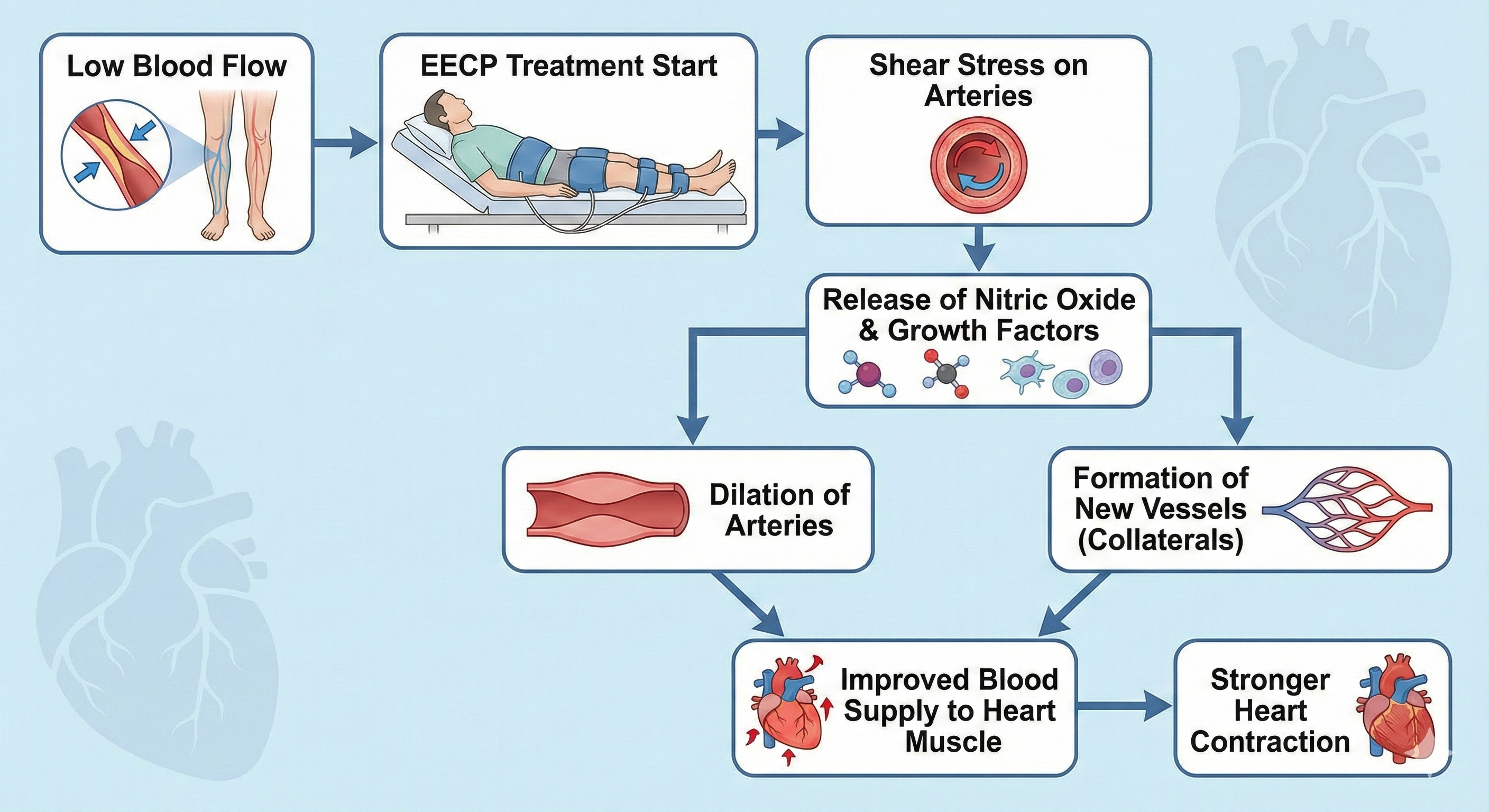
2. The Shear Stress Theory & Angiogenesis
The long-term benefits of EECP Treatment for Cardiomyopathy are biological, not just mechanical. The increased velocity of blood flow creates “shear stress” on the inner lining of the blood vessels (endothelium).
This friction is a biological signal. It triggers the endothelium to release beneficial chemicals:
- Nitric Oxide (NO): A powerful vasodilator that widens arteries and lowers blood pressure.
- VEGF (Vascular Endothelial Growth Factor): A protein that signals the body to grow new blood vessels.
- Anti-inflammatory Cytokines: Reduces chronic inflammation in the blood vessels.
Through these mechanisms, EECP Treatment for Cardiomyopathy literally remodels the vascular system, making it more efficient and robust.
Pathogenesis Flowchart
Diagnosis & Eligibility
Before starting EECP Treatment for Cardiomyopathy, the following are checked:
-
2D Echocardiography: To check the Ejection Fraction (LVEF) and valve function.
-
ECG: To monitor heart rhythm.
-
History: Review of angina symptoms and medication history.
Treatment Protocol
-
Standard Course: A typical course consists of 35 sessions.
-
Duration: Each session lasts exactly 1 hour.
-
Frequency: Sessions are done 5 to 6 days a week for roughly 6 to 7 weeks.
-
The Experience: The patient lies on a bed. Electrodes are attached to the chest to monitor the ECG. Cuffs are wrapped around the legs. The machine starts pumping gently and increases pressure as the patient gets comfortable.
Monitoring
During the session, Oxygen saturation (SpO2) and Heart Rate are continuously monitored. A technician is always present to adjust cuff pressure for maximum benefit.
Long Term Follow-up
After the 35 sessions, a follow-up Echo is done to measure improvement in LVEF. Maintenance sessions (1 or 2 per week) may be recommended for severe cases to maintain the EECP treatment outcomes in heart failure.
EECP Treatment for Cardiomyopathy vs. Conventional Treatments
| Feature | EECP Treatment for Cardiomyopathy | Angioplasty (PCI/Stent) | Bypass Surgery (CABG) |
|---|---|---|---|
| Invasiveness | Completely Non-Invasive | Minimally Invasive | Highly Invasive (Open Heart) |
| Anesthesia | None | Local + Sedation | General Anesthesia |
| Mechanism | Systemic Blood Flow Improvement | Localized Opening of Blockage | Surgical Rerouting of Blood |
| Hospital Stay | Outpatient (Go home daily) | 1–2 Days | 5–10 Days |
| Recovery Time | Immediate | 1 Week | 3–6 Months |
| Risk of Death | Negligible | Low | Moderate to High |
| Repeatability | Can be repeated easily | Limited by vessel health | Difficult to repeat |
| Cost | Moderate | High | Very High |
| Primary Goal | Improve Function & Symptoms | Fix Anatomy | Fix Anatomy |
The Role of Nutrition in Heart Recovery
While mechanical therapies provide the necessary push for better circulation, the fuel for the heart comes from what we eat. A heart-healthy diet is the foundation of long-term success. Patients are strongly encouraged to adopt a plant-based or Mediterranean-style diet rich in antioxidants, magnesium, and omega-3 fatty acids. These nutrients reduce inflammation in the arterial walls and support the endothelial function that external counterpulsation works so hard to restore. Hydration is equally critical, as it determines blood viscosity; easier-flowing blood means less strain on a recovering heart muscle. integrating these dietary changes ensures that the benefits gained during therapy are sustained for years.
The Importance of Family and Emotional Support
Recovery is rarely a solo journey. The role of family members and caregivers is pivotal in the management of chronic heart conditions. Emotional stress triggers the release of cortisol and adrenaline, hormones that can constrict blood vessels and counteract healing efforts. Having a supportive environment where caregivers understand the treatment schedule and the need for rest can significantly lower a patient’s stress levels. Simple acts, like accompanying a patient to their daily sessions or preparing heart-friendly meals, create a safety net that encourages the patient to stick to the protocol and maintain a positive outlook throughout the healing process.”
Key Benefits of EECP Treatment for Cardiomyopathy
The advantages of choosing EECP Treatment for Cardiomyopathy extend beyond just heart health. It is a systemic therapy that benefits the whole body.
1. Increases Exercise Tolerance
Patients with cardiomyopathy often cannot walk far without breathlessness. Clinical trials show that EECP Treatment for Cardiomyopathy increases peak oxygen consumption (VO2 max) and extends the duration patients can exercise.
2. Reduces Angina and Heart Failure Symptoms
The most immediate benefit is the reduction of chest pain (angina) and shortness of breath. By reducing the heart’s workload, EECP Treatment for Cardiomyopathy allows patients to perform daily tasks like grocery shopping or climbing stairs without distress.
3. Improves Left Ventricular Function
For patients with a low Ejection Fraction (LVEF < 35%), EECP Treatment for Cardiomyopathy can lead to a measurable improvement in pumping capacity. By waking up “hibernating” myocardium (stunned heart muscle), the heart begins to contract more vigorously.
4. Psychological Wellbeing
Chronic heart disease leads to anxiety and depression. By restoring physical capability and reducing hospital visits, EECP Treatment for Cardiomyopathy significantly improves mental health and social functioning.
5. Peripheral Benefits (Kidneys and Brain)
Because it improves blood flow system-wide, EECP Treatment for Cardiomyopathy helps other organs. It increases blood flow to the brain (helping with cognitive decline) and the kidneys (improving filtration rates in cardiorenal patients).
6. Corrects Endothelial Dysfunction
The therapy heals the lining of the arteries. This means EECP Treatment for Cardiomyopathy helps prevent future plaque buildup, acting as a preventative measure against future heart attacks.
Limitations and Contraindications
While EECP Treatment for Cardiomyopathy is a miracle therapy for many, it is not suitable for every single patient. Safety is paramount, and there are specific conditions where the therapy is avoided.
Absolute Contraindications
- Severe Aortic Regurgitation: If the heart valve leaks significantly, the backward pressure from EECP Treatment for Cardiomyopathy can worsen the leak.
- Deep Vein Thrombosis (DVT): If there is a blood clot in the leg, the pressure cuffs could dislodge it, causing a pulmonary embolism.
- Pregnancy: The therapy is not performed on pregnant women.
- Abdominal Aortic Aneurysm (AAA): Large aneurysms may be at risk due to increased abdominal pressure.
Possible Side Effects
EECP Treatment for Cardiomyopathy is generally well-tolerated. Minor side effects may include:
- Skin chafing or bruising under the cuffs.
- Muscle fatigue or soreness (similar to a gym workout).
- Paresthesia (tingling) in the legs during the session.
Patients with severe Peripheral Artery Disease (PAD) in the legs may find the pressure uncomfortable, but adjustments to the pressure settings often make EECP Treatment for Cardiomyopathy possible for them.
The Clinical Pathway: What to Expect
If you choose to undergo EECP Treatment for Cardiomyopathy, it is helpful to understand the clinical journey from diagnosis to completion.
Phase 1: Evaluation and Eligibility
Before starting, a cardiologist will evaluate your suitability for EECP Treatment for Cardiomyopathy.
- Tests: Echocardiogram, ECG, and a review of your angiograms.
- Medication Review: You generally stay on your current meds, though blood thinners are monitored.
- Goal Setting: Defining what “success” looks like for you (e.g., walking without pain).
Phase 2: The Treatment Protocol
The standard protocol for EECP Treatment for Cardiomyopathy is rigorous but effective.
- Duration: 35 hours total.
- Frequency: 1 hour per day, 5 days a week, for 7 weeks.
- The Experience: You lie on a padded bed. Electrodes are placed on your chest. Cuffs are wrapped around your legs. You will feel a strong “hug” moving up your legs. It is rhythmic and rarely painful. Most patients read, listen to music, or sleep during EECP Treatment for Cardiomyopathy.
Phase 3: Mid-Course Assessment
Around the 15th to 20th session, doctors often assess progress. Many patients undergoing EECP Treatment for Cardiomyopathy begin to feel “lighter” and more energetic at this stage.
Phase 4: Completion and Maintenance
After 35 sessions, a final evaluation is done. While the benefits of EECP Treatment for Cardiomyopathy last for years, some patients with severe disease may opt for “maintenance” sessions (e.g., once or twice a week) to sustain the benefits indefinitely.
Clinical Research and Studies
| Study Name / Year | Focus | Key Findings |
|---|---|---|
| MUST-EECP Trial (1999) | Angina & Quality of Life | Demonstrated that EECP significantly increased time to exercise-induced ischemia. Patients could walk longer without pain. |
| PEECH Trial (2005) | Heart Failure (Cardiomyopathy) | A randomized controlled trial showing that EECP improved exercise duration and NYHA functional class in heart failure patients. |
| Soran et al. (2002) | Safety in Heart Failure | Proved that EECP is safe and effective for patients with severe left ventricular dysfunction (Low EF). |
| Loh et al. (2008) | Long Term Mortality | Showed that patients who completed EECP therapy had better survival rates and fewer cardiac events over a 3-year follow-up. |
| Zhang et al. (2010) | Angiogenesis | Confirmed increased levels of Nitric Oxide and VEGF in patients undergoing EECP, proving the growth of new blood vessels. |
Systemic Benefits: Beyond the Heart
One of the most fascinating aspects of EECP Treatment for Cardiomyopathy is its “pleiotropic” or multiple effects. Because the cardiovascular system connects to every organ, improving it helps the whole body.
- Erectile Dysfunction (ED): Many heart patients suffer from ED due to poor vascular flow. EECP Treatment for Cardiomyopathy improves pelvic blood flow, often resolving ED issues without medication.
- Long COVID: Emerging research suggests EECP helps Long COVID patients suffering from fatigue and brain fog by repairing endothelial damage caused by the virus.
- Diabetes: By improving micro-circulation, EECP Treatment for Cardiomyopathy can improve insulin sensitivity and help with diabetic neuropathy.
The Patient Experience
The daily sessions are designed to be passive and stress-free, often becoming a time of relaxation rather than a medical burden. Since the procedure requires no active effort from the patient, many choose to use this hour to decompress. Patients frequently listen to calming music, read a book, or even take a nap while the rhythmic compression acts like a deep tissue massage for the legs. This period of enforced rest, combined with the physiological boost of improved circulation, often leaves individuals feeling refreshed immediately after the session, transforming the clinic visit into a daily wellness ritual.
Maintaining the 'New' Blood Vessels
Sustainability is key to any cardiac intervention. Once the initial course has successfully stimulated the growth of collateral vessels, the goal shifts to keeping these new pathways open. These tiny natural bypasses rely on consistent blood flow to stay functional. Therefore, doctors often prescribe a regimen of regular, light exercise—such as walking or yoga—to maintain the blood velocity required to keep these vessels dilated. Additionally, strictly managing risk factors like cholesterol and blood pressure is non-negotiable. The therapy provides a powerful ‘reset’ for the vascular system, but a disciplined lifestyle is what ensures those results last for years.
K. Frequently Asked Questions (FAQs)
- Is EECP Treatment for Cardiomyopathy painful?
No. It is a non-invasive, external pressure therapy. Patients feel a strong squeezing sensation, but it should not be painful. Pressure can be adjusted for comfort.
- Can I drive myself home after the session?
Yes. Since EECP Treatment for Cardiomyopathy requires no sedation or anesthesia, you can drive, work, and function normally immediately after the session.
- Is it covered by insurance?
In the USA, Medicare covers EECP for refractory angina. Coverage for heart failure varies by provider. In other countries, coverage for EECP Treatment for Cardiomyopathy depends on local health policies.
- Can I have EECP if I have stents or a pacemaker?
Yes. Patients with stents or bypass grafts are excellent candidates. Patients with pacemakers can also undergo EECP Treatment for Cardiomyopathy provided the machine can synchronize with the paced rhythm.
- How long do the results last?
Clinical data suggests the benefits of a full course of EECP Treatment for Cardiomyopathy last between 3 to 5 years. This depends on the patient maintaining a healthy lifestyle.
- Is this a replacement for my heart medication?
You should not stop medication without doctor orders. However, many patients find that after completing EECP Treatment for Cardiomyopathy, their need for anti-anginal medications (like nitrates) decreases.
- Why haven’t I heard of this before?
Invasive cardiology (stents/surgery) has dominated the field for decades. However, as the limitations of surgery for chronic patients become clear, EECP Treatment for Cardiomyopathy is gaining rapid recognition as a standard of care.
- Is there an age limit?
No. EECP Treatment for Cardiomyopathy has been successfully performed on patients in their 90s. Because it is low-risk, age is rarely a barrier.
Final Summary
Cardiomyopathy is a serious condition, but it does not have to define the limits of your life. For too long, patients have felt trapped between the limitations of medication and the fear of open-heart surgery. EECP Treatment for Cardiomyopathy offers a third path—one that is non-invasive, safe, and scientifically proven.
By enhancing blood flow, promoting the growth of natural bypass vessels, and reducing the workload on the failing heart, this therapy addresses the root physiological problems of heart failure. The clinical evidence is clear: EECP Treatment for Cardiomyopathy improves quality of life, increases exercise capacity, and restores hope.
If you are suffering from chronic chest pain, fatigue, or breathlessness due to a weak heart, discussing EECP Treatment for Cardiomyopathy with your cardiologist could be the most important step you take toward a healthier, more active future.
Disclaimer: This content is for informational purposes only and does not constitute medical advice. Always consult with a qualified healthcare provider regarding EECP Treatment for Cardiomyopathy or any other medical condition.
Book An Appointment With Us
Experience top-quality healthcare at NexIn Health Clinic. Schedule your appointment with our expert team today for personalized and compassionate medical care. Book now to prioritize your health and well-being!
Get Appointment With Nexin health
Choose Nexin healthy For Heart
Treatments!
- TAVI/TAVR
- Heart Surgery
- ASD/VSD/PDA Device
- Device Closure
- Angina Treatment
- Heart Failure
- Heart Attack
- Chest Pain
- Hypertension
- Heart Diseases
- Heart Holes Surgery

13 Years of Experience
Our clinic has a rich history of delivering quality care, backed by over a decade of expertise in the field.
25,000 Patients Treated
We have a proven track record of successfully treating a diverse range of patients, demonstrating our commitment to effective and personalised care.
Non-Invasive Treatments
We specialise in advanced, non-invasive treatment options that focus on your well-being without the need for surgical procedures.

Our Main Treatments
EECP
Heart Blockage
Heart Failure
Angina
Chest Pain

13+
Experience

25+
Certified Therapists

25000+
Satisfied Patients
Book An Appointment
Contact us