


NexIn Health - Integrated Health Centre
At NexIn Health, we take pride in being a trusted name in Enhanced External Counterpulsation (EECP) treatment across India. Renowned for our commitment to excellence, NexIn Health is a leading organisation dedicated to providing innovative, non-invasive cardiac care solutions (EECP Therapy in India) and Chelation Therapy in India. Our team comprises highly skilled doctors and healthcare professionals who specialise in delivering cutting-edge heart care through Integrated Therapies EECP therapy, Chelation Therapy, DETOX Therapies, and Other Non – non-invasive treatments, ensuring personalised and effective treatment for every patient.
With a focus on pioneering advancements in non-invasive cardiology, NexIn Health (EECP Treatment and Chelation Therapy in India) is redefining heart care by combining expertise, technology, and compassion. Whether you’re seeking preventive care or advanced treatment, we are here to support your journey toward better heart health. Discover the future of integrated healthcare with NexIn Health – where innovation meets care.
Introduction
Do you often have cold hands and feet, or do your legs hurt after walking a short distance? These are not just signs of getting older; they are often signs that your body is having trouble getting blood to where it needs to go. A lot of people think that the only way to fix these problems is with drugs or surgery, but modern medicine has a safer way. This is where EECP Treatment for Poor Blood Circulation comes in as a groundbreaking answer.
Enhanced External Counterpulsation (EECP) is a scientifically proven, non-invasive treatment that can help your heart pump blood more effectively without any cuts. You can think of it as a “second heart” that helps your natural heart rest and heal from the outside. It helps your blood flow by working mechanically, which makes your heart work less hard and opens up new routes for blood to move around your body.
The FDA has approved this treatment for treating chronic chest pain (angina) and heart failure, but it can help with a lot more than just heart problems. Doctors all over the world are now using this Non-Surgical Treatment for Poor Blood Circulation to help people with Peripheral Artery Disease (PAD), diabetes-related circulation problems, and chronic fatigue. It is a safe, approved, and very effective way to get your energy back and make your life better.
Key Numbers About EECP Treatment for Poor Blood Flow
| Category | Important Fact or Statistic |
|---|---|
| Global Prevalence | More than 200 million people worldwide have Peripheral Artery Disease (PAD), a major cause of poor blood circulation |
| Success Rate | Clinical studies show EECP treatment improves symptoms in 75%–85% of patients |
| New Vessel Growth | EECP significantly increases VEGF (Vascular Endothelial Growth Factor), promoting natural bypass vessel formation |
| Length of Treatment | A standard EECP course lasts 35 hours (1 hour per day for 7 weeks) |
| Safety Profile | As a non-surgical therapy, EECP has a safety rate of over 99%, far safer than bypass surgery |
| Medication Reduction | About 81% of patients report reduced Nitroglycerin use after completing therapy |
Did you know?
- The “Natural Bypass”: EECP Treatment for Poor Blood Circulation is often called a “natural bypass” because it helps the body grow new blood vessels around blockages, just like a tree grows new roots.
- Silent Danger: If you don’t get treatment for poor circulation, it can lead to serious problems like stroke, heart attack, or even amputation.
- Exercise Equivalent: One hour of EECP therapy for heart and vascular health gives the same circulatory benefits as exercising, making it perfect for people who can’t run or walk long distances because of pain.
What is EECP Treatment for Bad Blood Flow?
To really understand how valuable this therapy is, we need to know what it treats and how the science behind it works.
Understanding the Problem: Bad Blood Flow
When blood flow to certain parts of your body, like your heart, legs, brain, or kidneys, is slowed down or stopped, you have poor blood circulation. Atherosclerosis, which is when plaque builds up inside the blood vessels and makes them hard, is the most common cause of this.
When arteries get narrow or hard, blood that is full of oxygen can’t get to your muscles and organs. This lack of oxygen causes bad symptoms like:
- Numbness, tingling, or “pins and needles” in the arms and legs.
- Muscle cramps or very bad pain when walking (this is called Claudication).
- Hands and feet that are always cold, even when it’s warm.
- Wounds take a long time to heal, especially on the legs and feet.
- Feeling tired all the time and having trouble breathing when doing simple things.
The Answer: EECP Treatment for Bad Blood Flow
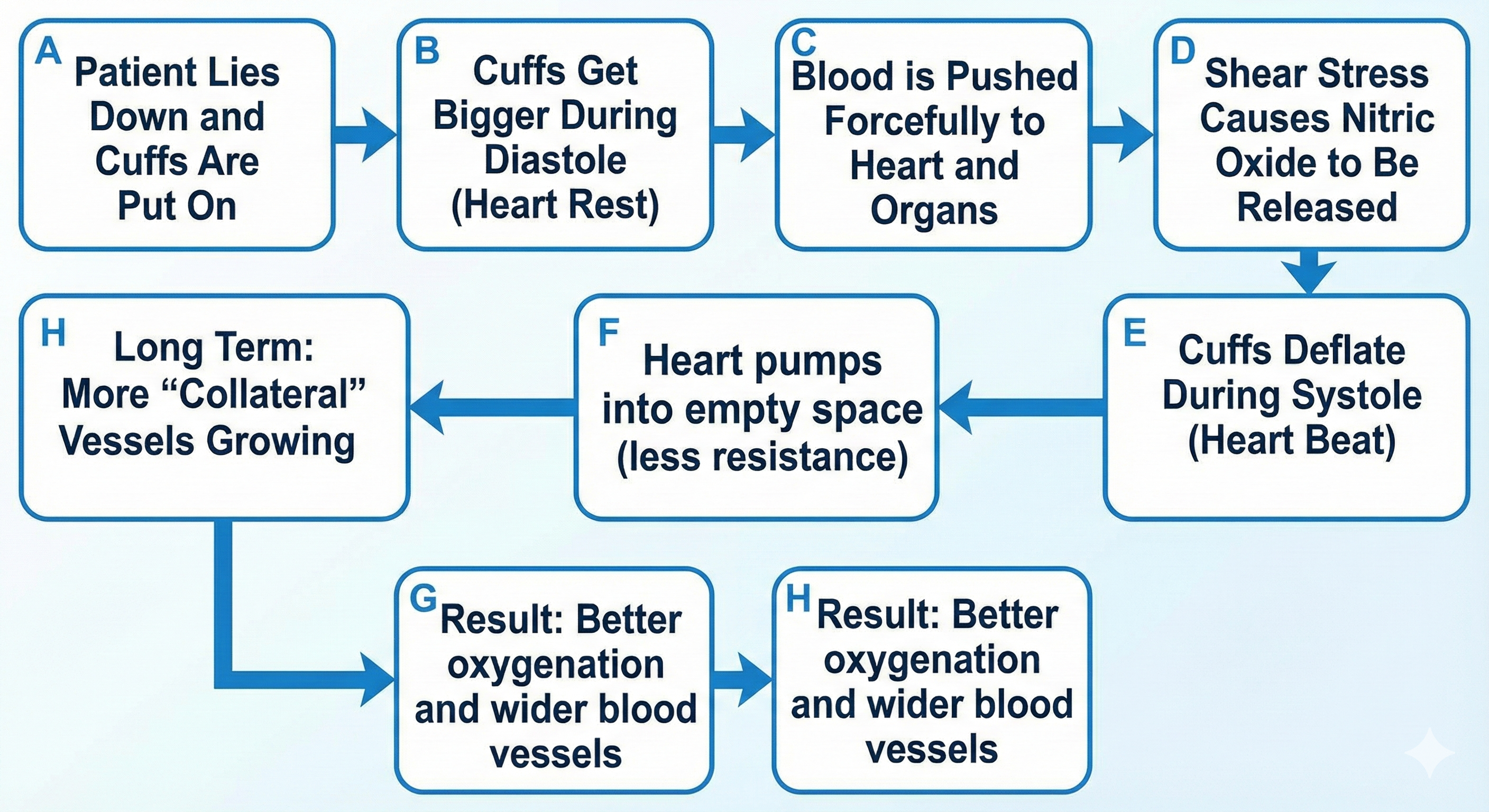
EECP Treatment for Poor Blood Circulation is an outpatient therapy that uses localised air pressure to improve circulation. The patient lies on a comfortable treatment bed, and pneumatic cuffs, which are like blood pressure cuffs, are wrapped around their calves, thighs, and buttocks. These cuffs fill up and empty out at the same time as your heart beats.
A computer that watches your ECG (heart rhythm) controls this timing. The goal is to get more blood back to the heart and raise the pressure that pushes blood through the coronary arteries and the rest of the body.
How It Works: The Science Made Easy
The EECP Treatment for Poor Blood Circulation works by using three main physical actions that work together to change the way your blood vessels work:
- Diastolic Augmentation (The Boost): The cuffs fill up one at a time, starting at the calves and moving up to the thighs, while your heart is at rest (diastole). This “milking” motion pushes blood from your legs back up to your heart. This extra rush of blood feeds the heart muscle itself, which only gets blood when it is at rest.
- Systolic Unloading (The Vacuum): The cuffs deflate right before your heart beats (systole). This causes a sudden drop in pressure in your legs, which makes a “vacuum effect.” This makes it much easier for your heart to pump blood into the arteries, which greatly lessens the strain on the heart muscle.
- Shear Stress & Nitric Oxide (The Healer): When blood flows faster and in larger amounts, it puts “shear stress” on the inside walls of your arteries. This friction makes the endothelium, which is the lining of the blood vessels, release Nitric Oxide, a strong natural gas that relaxes and opens up blood vessels.
What Is It Needed For?
A lot of people with bad circulation can’t have surgery because they are too old, have diabetes, or have other health risks. Some people may have already had surgery, such as stents or bypass, but they still have symptoms. EECP Treatment for Poor Blood Circulation fills this important need. It offers a natural way to improve blood flow without the risks that come with invasive procedures.
What You Can Expect
People who get EECP Therapy for Poor Blood Circulation often say:
- More ability to walk longer distances without hurting their legs.
- Warmer hands and feet as blood flows to the ends of the body.
- More energy and less tiredness every day.
- Less need for painkillers and Nitric Glycerin.
- Better mental clarity because more blood flows to the brain.
EECP Treatment for Poor Blood Circulation vs. Other Common Treatments
| Feature | EECP Treatment for Poor Blood Circulation | Angioplasty / Stenting | Bypass Surgery (CABG) |
|---|---|---|---|
| Invasiveness | Non-invasive (no cuts or needles) | Invasive (catheter insertion) | Very invasive (open heart surgery) |
| Hospital Stay | None (outpatient therapy) | Usually 1–2 days | Usually 5–10 days |
| Recovery Time | Immediate (go home after one hour) | 1–2 weeks | 2–3 months |
| Risk Factors | Very low (minor skin irritation or fatigue) | Bleeding, vessel damage, blood clots | Infection, stroke, anaesthesia risks |
| Cost | Usually less expensive | Costly | Very costly |
| Focus | Improves overall global circulation | Treats a specific local blockage | Bypasses selected blockages |
| Repeatability | Can be safely repeated if needed | Repeat possible with increased risk | Difficult to repeat |
Summary: Surgery focuses on fixing blockages in specific areas, while EECP treatment improves the health of the entire vascular system. For patients seeking treatment for poor blood circulation without surgery, EECP is often the preferred option.
Main Benefits of EECP Treatment for Poor Blood Flow
Patients and doctors both like EECP Treatment for Poor Blood Circulation for a lot of reasons. These are the most important benefits:
- Not invasive at all: There are no cuts, needles, or anaesthesia needed. You just lie down on a comfortable treatment bed for an hour, so it’s not stressful.
- Encourages Natural Bypass (Angiogenesis): It helps small blood vessels grow. These new blood vessels work as a natural diversion around blocked arteries, bringing blood back to tissues that need oxygen.
- Reduces Medication Dependence: After finishing the course of EECP therapy for chronic ischaemia, many patients find they can lower the dose of their blood pressure or angina medications.
- Improves Walking Distance: This treatment greatly increases the distance that people with Peripheral Artery Disease (PAD) can walk before they start to feel leg pain (claudication distance).
- Improves Sexual Function: Erectile Dysfunction (ED) is often caused by poor blood flow. EECP therapy for heart and vascular health can help restore function in this area by improving blood flow to the pelvis.
- Increases Energy and Stamina: Patients feel less tired and more energetic all day long because their muscles and organs get more oxygen. This lets them enjoy life again.
- No Recovery Time Needed: You can drive yourself to the clinic, get your treatment, and then drive back to work or home right away, unlike with surgery. There is no time off.
- Safe for High-Risk Patients: This is a great choice for older people or people with diabetes who are too high-risk for surgery or anaesthesia that requires cutting into the body.
- Better Quality of Sleep: Better circulation helps people relax and eases muscle cramps at night, which can help them sleep deeper and more restfully.
- Cost-Effective Solution: For many families, EECP for Blood Circulation is a less expensive option than hospitalisation, operating rooms, and post-surgery care.
- Holistic Health Improvement: It doesn’t just help the heart; it also improves blood flow to the kidneys, brain, and skin, which makes all of the organs healthier and more active.
- Long-Lasting Results: The benefits of a full course of EECP Treatment for Poor Blood Circulation can last for years (typically 3 to 5 years), especially if you live a healthy life.
Limitations and Potential Disadvantages of EECP Therapy for Impaired Circulation
It’s important to be honest about the limits of EECP Treatment for Poor Blood Circulation, even though it works very well. Not everyone can use it.
Who Should Not Get This Treatment? (Contraindications)
- Severe Aortic Regurgitation: If your heart valve leaks a lot, the back-pressure from EECP could be bad for you.
- Deep Vein Thrombosis (DVT): If you have an active blood clot in your leg, the cuffs could push it out of place, which is dangerous.
- Pregnancy: It is not usually safe for pregnant women to do because it puts pressure on the abdomen and pelvis.
- Severe High Blood Pressure: If your blood pressure is higher than 180/110 mmHg and you can’t control it, you need to take medicine before starting therapy.
- Open Wounds: If you have big open sores on your legs where the cuffs are, you need to wait for them to heal so you don’t get an infection.
Possible Side Effects
Most side effects are mild and go away quickly:
- Skin Irritation: Some patients may get chafed or bruised skin under the cuffs. This usually doesn’t happen when you wear padded clothes.
- Tiredness: Your body may feel tired after the first few sessions as it gets used to the “passive exercise.”
- Muscle Soreness: Your leg muscles may feel a little sore at first, just like when you go to the gym, but this usually goes away quickly.
Clinical Pathway: How EECP Deals with the Main Problem
This part talks about the medical journey and the biological process that makes EECP Treatment for Poor Blood Circulation work to fix the underlying problem of ischaemia (not enough blood flow).
Pathogenesis: How It Heals
- Shear Stress Induction: The quick movement of blood makes the walls of the arteries rub against each other more.
- Endothelial Activation: This friction “wakes up” the endothelium, which is the blood vessel’s inner lining.
- Release of Nitric Oxide: The endothelium lets go of Nitric Oxide and Prostacyclin. These are strong vasodilators, which means they open up blood vessels.
- Inhibition of Endothelin: It lowers the level of Endothelin-1, which makes blood vessels tighten and harden.
- Angiogenesis: Repeated stimulation causes the release of growth factors (VEGF), which makes new capillaries grow.
A flowchart of how the treatment works
Step-by-Step Clinical Protocol
- Step 1: Diagnosis & Eligibility: To make sure you have poor circulation and that EECP Treatment for Poor Blood Circulation is safe for you, the doctor will do an ECG, an echocardiogram, and maybe an ABI (Ankle-Brachial Index) test.
- Step 2: Getting Ready for the Procedure: You will need to wear thin, comfortable cotton trousers, like yoga trousers. Sensors are put on your chest to keep an eye on your heart rate.
- Step 3: The Treatment Session: You lie down on the bed. Cuffs go around the calves, thighs, and buttocks. The machine starts off slowly, and the pressure rises until the monitor shows that the augmentation is working.
- Step 4: Monitoring: A trained technician keeps an eye on your heart rate, blood pressure, and oxygen levels for the whole hour.
- Step 5: Finish and follow up: A full course usually has 35 sessions. After three months, follow-up scans are done to see how much better the flow and walking distance are.
Clinical Research & Studies on EECP Treatment for Poor Blood Circulation
| Name of Study / Year | Area of Study | Main Results & Stats |
|---|---|---|
| The MUST-EECP Trial (1999) | Angina | Showed that EECP reduced angina episodes and increased the time to ischaemia during exercise. |
| PEECH Trial (2005) | Heart Failure | Heart failure patients experienced significant improvements in exercise duration and daily functional capacity. |
| The Mayo Clinic Study (2002) | Survival Rates | Found that EECP patients had similar five-year survival rates compared with those undergoing revascularisation surgery. |
| Braith et al. (2010) | Peripheral Artery Disease | Demonstrated marked improvements in walking distance and leg blood flow following EECP therapy. |
| Zhang et al. (2012) | Stroke / Ischaemic Brain | Showed increased carotid artery blood flow, supporting improved recovery after ischaemic stroke. |
Common Questions About EECP Treatment for Bad Blood Flow
Q1. Does EECP treatment hurt when blood doesn’t flow well?
Ans: No, the treatment doesn’t hurt. Your legs will feel like they are being hugged or squeezed hard, but it shouldn’t hurt. Most patients say it has a steady beat and makes them feel relaxed, and they often fall asleep during the session.
Q2. How long does it take to get results?
Ans: After 15 to 20 sessions of EECP Treatment for Poor Blood Circulation, most patients start to feel better, with more energy and less pain.
Q3. Does insurance cover this?
Ans: Medicare and private insurance cover Angina in a lot of places, including the US. But depending on your provider, using EECP for Blood Circulation in legs (PAD) might be considered “off-label” coverage, so check with your plan.
Q4. Can I walk right after the treatment?
Ans: Yes, there is no time to recover. After your session of Non-Surgical Treatment for Poor Blood Circulation, you can walk, drive, and get back to your normal routine right away.
Q5. Is it safe for diabetics to use EECP?
Ans: Yes, EECP therapy for heart and vascular health is great for people with diabetes. It helps microcirculation, which is often hurt by high blood sugar levels.
Q6. What happens if I miss a session?
Ans: For the best results, you should be consistent. But if you miss a day, you can just add it to the end of your schedule. The most important thing is how the 35 hours add up.
Q7. Can I get EECP if I have a pacemaker?
Ans: Yes, today’s EECP machines can work with pacemakers. Your technician will change the settings to make sure that the timing is just right for your paced rhythm.
Q8. What makes this different from a massage?
Ans: A massage works on your muscles. EECP Treatment for Poor Blood Circulation works on the timing of blood flow and the arteries. It is a medical procedure that works with your heartbeat, which a massage can’t do.
Q9. Does it help with cold hands and feet?
Ans: Yes, for sure. One of the first signs that a treatment is working is that the patient’s hands and feet feel warmer. This is because the blood flow to the extremities is better.
Q10. Can it completely clear blocked arteries?
Ans: It doesn’t physically get rid of the plaque like a roto-rooter does. Instead, it makes the vessel wider and creates “collaterals,” which are natural bypasses that let blood flow around the blockage.
Q11. Is there a maximum age for this therapy?
Ans: There is no age limit. We have successfully helped patients in their 90s who were looking for a Poor blood circulation treatment without surgery.
Q12. Can I eat before the procedure?
Ans: A light meal an hour or two before is a good idea. To stay comfortable while the abdominal cuffs are inflating, don’t eat a lot right before the session.
Q13. What should I put on?
Ans: Wear soft, thin cotton leggings or track pants that fit snugly. This stops the cuffs from rubbing against bare skin and causing irritation.
Q14. Will the results last?
Ans: The results can last for a long time. You still need to eat well and live a healthy life, though. Some patients choose to have “maintenance sessions” once a week after the main course to keep their blood flow healthy.
Q15. Can EECP help with ED (erectile dysfunction)?
Ans: Yes, because ED is often a problem with the blood vessels that is caused by not enough blood flow. Many men say that after a full course of EECP therapy benefits, they feel better because their pelvic circulation has improved.
Final Summary
EECP Treatment for Poor Blood Circulation is a new way of thinking about how to take care of our vascular health. It stops using invasive cuts and stents and instead uses the body’s natural ability to heal and adapt. This Non-Surgical Treatment for Poor Blood Circulation is a safe, effective, and scientifically proven way to get better if you have heart problems, leg pain from PAD, or just feel tired all the time.
This therapy is worth considering if you want to improve your quality of life or if you need a EECP treatment for blocked arteries. It’s not just about blood flow; it’s about getting your life back.
Expert Suggestion: Talk to a cardiologist or a vascular specialist today to find out if you are a good candidate for EECP Treatment for Poor Blood Circulation. Your heart and health deserve the best care they can get.
Book An Appointment With Us
Experience top-quality healthcare at NexIn Health Clinic. Schedule your appointment with our expert team today for personalized and compassionate medical care. Book now to prioritize your health and well-being!
Get Appointment With Nexin health
Choose Nexin healthy For Heart
Treatments!
- TAVI/TAVR
- Heart Surgery
- ASD/VSD/PDA Device
- Device Closure
- Angina Treatment
- Heart Failure
- Heart Attack
- Chest Pain
- Hypertension
- Heart Diseases
- Heart Holes Surgery

13 Years of Experience
Our clinic has a rich history of delivering quality care, backed by over a decade of expertise in the field.
25,000 Patients Treated
We have a proven track record of successfully treating a diverse range of patients, demonstrating our commitment to effective and personalised care.
Non-Invasive Treatments
We specialise in advanced, non-invasive treatment options that focus on your well-being without the need for surgical procedures.
Our Main Treatments
EECP
Heart Blockage
Heart Failure
Angina
Chest Pain

13+
Experience

25+
Certified Therapists

25000+
Satisfied Patients
Book An Appointment
Contact us