Heat Exhaustion vs Heart Attack: Symptoms, Causes & When to Seek Help
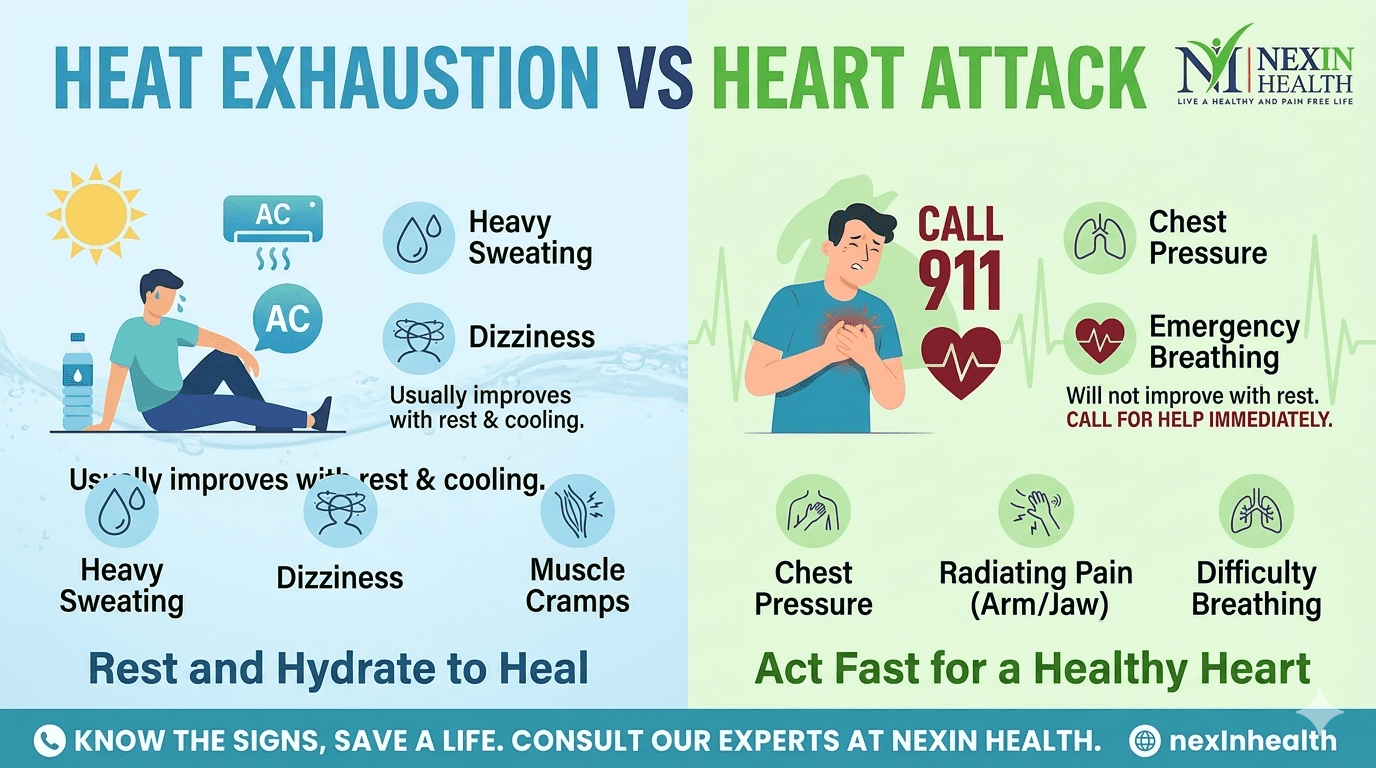



Heat Exhaustion vs Heart Attack Symptoms can look dangerously similar — and that confusion can cost lives. When temperatures rise during a harsh Indian summer, your body sends out warning signals. But are those signals telling you to drink water and rest — or to call an ambulance right away?
Every year, thousands of people across India and the world mistake the early signs of a heart attack for heat-related illness. They rest. They wait. They hope it passes. And for many — that delay is fatal. Knowing the difference between Heat Exhaustion vs Heart Attack Symptoms is not just useful medical knowledge. It is life-saving information you need right now.
What are the first signs of heat exhaustion? This is the most important question to answer before stepping outdoors in peak summer heat. Heat exhaustion happens when your body loses too much water and sodium — mainly through heavy sweating — and can no longer cool itself efficiently.
According to Cleveland Clinic, your core body temperature during heat exhaustion stays below 104°F (40°C). Above that level, it becomes the far more dangerous condition known as heat stroke.
The very first warning — muscle cramps. Known medically as exercise-associated muscle cramps or heat cramps, these painful, slow-tightening spasms — usually in the arms, legs, or abdomen — are your body’s earliest cry for help. If you ignore them and stay in the heat, heat exhaustion follows quickly.
Mild heat exhaustion symptoms to watch for:
These are classic heat sickssness symptoms in adults that many people dismiss as “just tiredness.” That dismissal is where the real danger begins. Heat Exhaustion vs Heart Attack Symptoms are easy to confuse at this stage — which is why understanding each one clearly matters so much.
Early Warning Signs of Heart Attack: The Key Differences
The early warning signs of heart attack share some overlap with heat exhaustion — but have important distinguishing features that you must know. A heart attack occurs when blood flow to the heart muscle is blocked, usually by a blood clot in a narrowed artery. Unlike heat exhaustion, it does not need heat, exertion, or dehydration to happen.
Classic heart attack warning signs include:
Critical point: The biggest difference when comparing Heat Exhaustion vs Heart Attack Symptoms is this — heart attack symptoms do NOT improve with rest, cooling, or water. If you lie down in air conditioning and drink fluids, heat exhaustion begins to improve within 15–30 minutes. A heart attack does not.
Understanding Heat Exhaustion vs Heart Attack Symptoms side by side removes confusion in a moment of crisis. Both conditions cause dizziness, sweating, and nausea in heat — which is exactly why so many people misread the situation.
| Symptom | Heat Exhaustion | Heart Attack |
|---|---|---|
| Chest Pain | Rare — usually absent | Common — pressure, tightness, or squeezing |
| Sweating | Heavy, triggered by heat | Cold, clammy sweat — not heat-related |
| Skin Condition | Cool, pale, moist | Can be normal, pale, or ashen |
| Pulse | Fast but weak | Rapid, slow, or irregular |
| Main Cause | High temperature + dehydration | Blocked blood flow to the heart |
| Improves with Rest & Cooling | Yes — within 15–30 minutes | No — symptoms persist or worsen |
| Pain Radiating to Arm or Jaw | No | Yes — a major red flag |
| Occurs Without Heat Exposure | No | Yes — can happen anytime, anywhere |
| Mental State | Alert, mild temporary confusion | Can progress to severe confusion |
| Emergency Level | Urgent — needs prompt action | Life-threatening — call emergency immediately |
Golden Rule: If you are unsure — always assume it is a heart attack. Call emergency services immediately. It is always better to be checked and wrong than to delay and lose heart muscle permanently.
Chest pain in hot weather causes more confusion than almost any other summer symptom. During Indian summers, when the heat index regularly crosses 40°C (104°F), chest discomfort is often brushed aside as “just the heat.” That assumption can be fatal.
Here is how to think through it:
It may be heat-related if:
Treat it as a cardiac emergency if:
According to Harvard Medical School research, patients with diabetes are more likely to experience silent or atypical heart attacks — with less chest pain and more fatigue, breathlessness, or nausea. This makes them especially vulnerable to misidentifying a heart attack as heat illness.
Never assume chest pain in summer is just the heat. When in doubt — act immediately.
Most people do not realize how directly dehydration and heart stress symptoms are linked. When your body loses fluids rapidly, your blood becomes thicker. A thicker blood volume is harder to pump — forcing your heart to work significantly harder, raising your heart rate, and increasing cardiac strain.
This connection is especially dangerous for:
A recent clinical study found that even mild dehydration — as little as 1–2% of body weight loss — can significantly elevate heart rate and reduce cardiac output in people with pre-existing conditions.
When you feel dizzy, weak, or notice a fast heartbeat in the heat, hydrate immediately. But if symptoms do not ease within 15–30 minutes of rest and fluids — seek medical attention without delay. Heat Exhaustion vs Heart Attack Symptoms can both involve a racing heart. The key is whether the symptoms improve with hydration and rest — or not.
Knowing heat exhaustion symptoms and treatment can prevent a manageable condition from becoming a life-threatening emergency. Speed matters. The faster you cool the body down, the better the chances of preventing escalation to heat stroke.
If you or someone nearby shows signs of heat exhaustion — do this immediately:
Do NOT:
According to Cleveland Clinic, most people recover from heat exhaustion within 1–2 days with proper treatment. However, if confusion, loss of consciousness, or a body temperature above 104°F (40°C) develops — this is no longer heat exhaustion. It is heat stroke — and it is a life-threatening emergency.
Understanding heat exhaustion vs heat stroke is critical — because one can rapidly become the other. Heat stroke is the most severe form of heat-related illness. It involves brain dysfunction and can cause permanent organ damage or death without immediate medical intervention.
| Feature | Heat Exhaustion | Heat Stroke |
|---|---|---|
| Body Temperature | Below 104°F (40°C) | Above 104°F (40°C) — dangerously high |
| Mental State | Alert, mild or temporary confusion | Persistent confusion, aggression, slurred speech |
| Sweating | Heavy sweating | May stop sweating — a critical danger sign |
| Skin | Cool, moist | Hot, flushed, dry or moist |
| Emergency Level | Urgent — treat immediately | Life-threatening — call 911 without delay |
According to Mayo Clinic, when a person’s core temperature hits 104°F or above, immediate aggressive cooling and emergency medical care are non-negotiable. Every minute of delay increases the risk of permanent brain damage, organ failure, and death.
Heat exhaustion vs heat stroke is not a minor distinction — it is the line between a recoverable condition and a medical catastrophe.
Heatwave health risks for heart patients are far greater than for the general population. During extreme heat, the heart must pump significantly more blood to the skin’s surface to release body heat. For someone with existing heart disease, this additional workload can trigger dangerous cardiac events.
Specific risks for heart patients during heat:
Safety precautions for heart patients and those with metabolic disorders during a heatwave:
The overlap between Heat Exhaustion vs Heart Attack Symptoms is most dangerous for this group — because they are at elevated risk for both conditions simultaneously.
| Treatment Approach | Heat Exhaustion | Heart Attack |
|---|---|---|
| First Response | Move to cool area, rest, hydrate | Call 911 immediately — do not wait |
| Cooling | Essential — cool towels, fans, AC | Not the primary treatment |
| Fluids | Oral water and electrolytes | IV fluids administered by medical professionals |
| Medication | Usually not required initially | Aspirin (if not allergic), cardiac drugs |
| Hospital Requirement | If no improvement in 30 minutes | Always — emergency treatment required |
| Diagnostic Tests | May need ECG to rule out cardiac cause | ECG, blood tests, angiography — all critical |
| Recovery Time | 1–2 days with proper rest | Weeks to months depending on severity |
| Long-Term Care | Lifestyle and hydration changes | Cardiac rehab, non-invasive integrated therapies |
Regardless of what you suspect — call emergency services immediately if you observe any of these:
Time is muscle. Every minute a heart attack goes untreated, more heart muscle dies — permanently. Do not drive yourself to the hospital. Call an ambulance so treatment can begin immediately on the way.
NexIn Health is a trusted healthcare center with 14+ years of experience, specializing in heart and spine treatment through non-invasive integrated techniques. Having consulted over 30,000 patients, NexIn Health combines advanced diagnostics with holistic, surgery-free approaches — helping patients recover faster, live better, and manage chronic conditions with precision and care.
Whether you are managing heart disease, recovering from a cardiac event, dealing with a metabolic disorder, or simply trying to understand your symptoms — NexIn Health’s expert team is here to guide you.
📞 Phone & WhatsApp: +91 9310145010
🌐 Website: www.nexinhealth.in
📧 Email: care@nexinhealth.in
Read More: Advanced EECP Therapy in Noida
Q1. Can heat exhaustion cause chest pain?
Yes, but it is usually mild and fades with rest and hydration. If the chest pain is intense, feels like pressure, or spreads to the arm or jaw — call emergency services immediately. Do not wait.
Q2. How quickly can heat exhaustion become dangerous?
Heat exhaustion can progress to life-threatening heat stroke in as little as 30 minutes if untreated, especially in elderly people, children, and those with chronic health conditions.
Q3. Can a heart attack happen in hot weather without any chest pain?
Yes. This is called a “silent heart attack.” It is more common in women and diabetics. Symptoms may include only unusual fatigue, jaw pain, nausea, or breathlessness — without any chest pain at all.
Q4. What are the first signs of heat exhaustion I should act on?
The first signs are usually muscle cramps, heavy sweating, weakness, and dizziness. Do not dismiss them. Move to a cool area and hydrate immediately before symptoms worsen.
Q5. Is dizziness during summer always related to heat?
Not always. Dizziness combined with chest tightness, shortness of breath, or arm pain can indicate a cardiac event. Never assume it is just the heat without ruling out other causes.
Q6. Can dehydration cause a heart attack?
Dehydration alone rarely causes a heart attack directly, but it significantly increases cardiac strain — especially in people with pre-existing heart conditions. It can be a contributing trigger in high-risk individuals.
Q7. Are heart attack symptoms different in women?
Yes. Women are more likely to feel unusual fatigue, nausea, back pain, jaw pain, and breathlessness rather than the classic chest pressure. This makes their symptoms easier to overlook — and more dangerous.
Q8. What should I do if I cannot tell whether it is heat exhaustion or a heart attack?
Always assume it is a heart attack. Call emergency services immediately. Getting checked and being wrong is far safer than delaying and suffering permanent heart damage.
Q9. Do people with diabetes get heat exhaustion more easily?
Yes. Diabetes impairs the body’s temperature regulation and speeds up fluid loss — making diabetics significantly more vulnerable to both heat exhaustion and cardiac events in hot weather.
Q10. What is the main difference between heat stroke and heat exhaustion?
Heat stroke is far more severe. The body temperature exceeds 104°F (40°C), and the person may become confused, stop sweating, or lose consciousness. It is a medical emergency requiring immediate care — not home treatment.
Q11. Which medications increase the risk of heat exhaustion?
Beta-blockers, diuretics, antihistamines, antipsychotics, and certain blood pressure medications can reduce the body’s ability to manage heat. If you take any of these, discuss summer precautions with your doctor.
Q12. Can heat exhaustion affect the heart rate?
Yes. Heat exhaustion causes a rapid but weak pulse. If the heart rate is also irregular or accompanied by chest discomfort — this is a warning sign of possible cardiac involvement and needs immediate evaluation.
Q13. How long does recovery from heat exhaustion take?
Most people recover within 1–2 days with proper rest and hydration. You should wait at least 48 hours after full recovery before returning to strenuous physical activity or outdoor work in the heat.
Q14. What is the safest time for outdoor activity during Indian summer?
Early morning (before 8 AM) or evening (after 6 PM) are the safest windows. Avoid outdoor exercise or heavy work between 11 AM and 4 PM, especially when the heat index is above 40°C.
Q15. How can NexIn Health help with heart-related concerns?
NexIn Health offers expert non-invasive cardiac evaluation, consultation, and integrated treatment plans designed specifically for heart patients, diabetics, and those with metabolic disorders. With 14+ years of experience and 30,000+ patients, they provide personalized, effective care. Reach them at +91 9310145010 or visit www.nexinhealth.in.


Experience

Certified Therapists

Satisfied Patients
Contact us