COURAGE Trial for Heart Patients: Scientific Evidence Comparing Angioplasty vs Medical Therapy
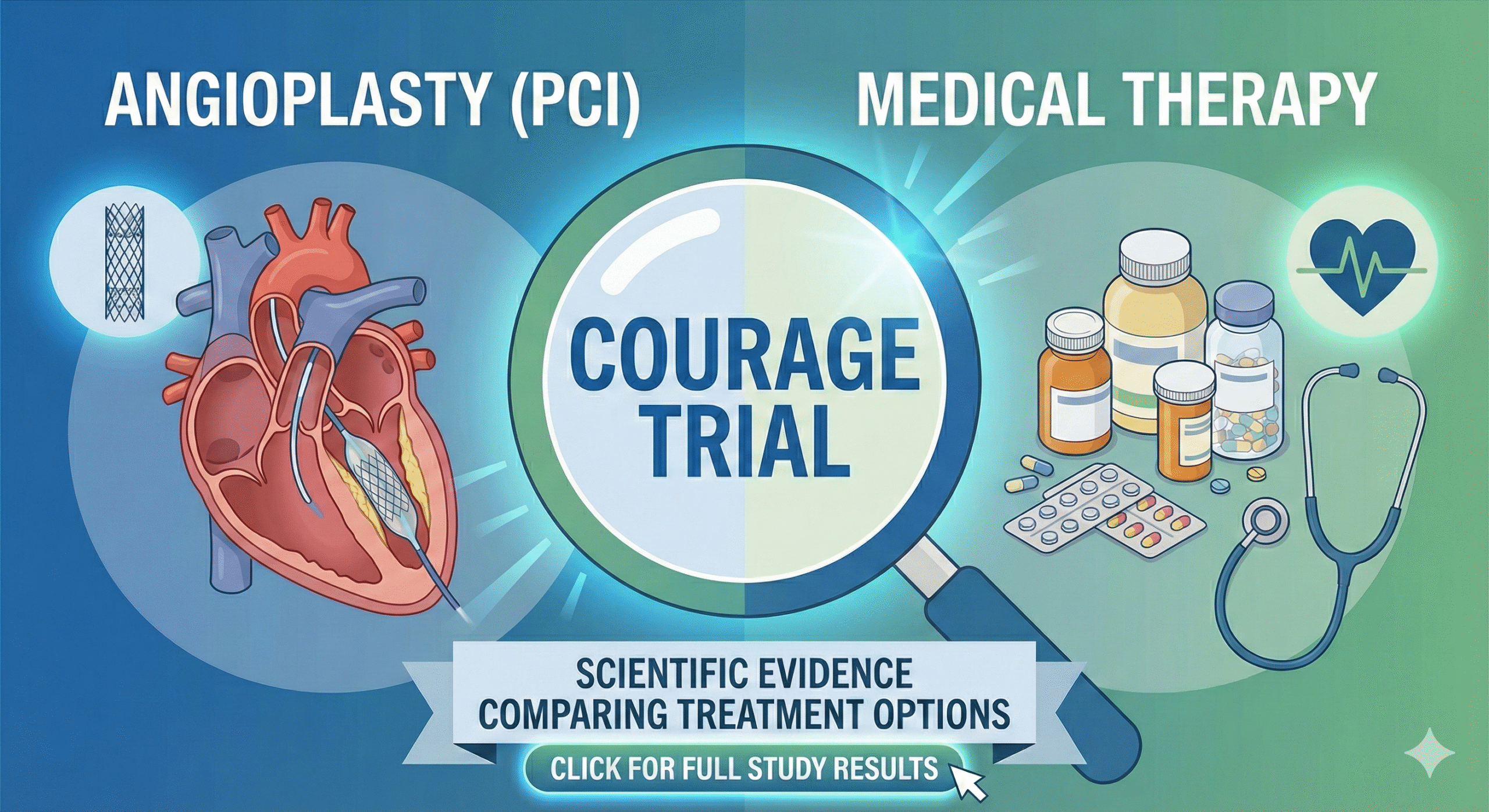


Study Name: Clinical Outcomes Utilizing Revascularization and Aggressive Drug Evaluation (COURAGE) Trial
Study Type: Randomized controlled trial
Sample Size: 2,287 patients
Study Duration: Median follow-up of 4.6 years (up to 7 years)
Study Locations: 50 hospitals across United States and Canada
Primary Finding: For patients with stable coronary artery disease, adding percutaneous coronary intervention (PCI/angioplasty with stents) to optimal medical therapy did not reduce the risk of death or myocardial infarction compared to optimal medical therapy alone.
Clinical Significance: Changed international treatment guidelines to recommend medical therapy first for stable coronary disease patients before considering invasive procedures.
The COURAGE Trial is a landmark randomized controlled trial published in 2007 that compared two treatment strategies for patients with stable coronary artery disease: percutaneous coronary intervention (PCI) plus optimal medical therapy versus optimal medical therapy alone.
Stable Coronary Artery Disease: A chronic condition where coronary arteries are narrowed by plaque buildup, causing predictable chest pain (angina) during exertion but not progressing to acute heart attack. Patients are clinically stable without sudden symptom changes.
Percutaneous Coronary Intervention (PCI): A minimally invasive procedure also called angioplasty where a catheter is inserted through an artery (typically in the groin or wrist) and guided to blocked coronary arteries. A balloon is inflated to widen the blockage, and a stent (metal mesh tube) is usually placed to keep the artery open.
Optimal Medical Therapy (OMT): A comprehensive treatment approach including antiplatelet medications (aspirin, clopidogrel), statins for cholesterol management, beta-blockers, ACE inhibitors or ARBs for blood pressure control, plus intensive lifestyle modification including diet, exercise, and smoking cessation.
Myocardial Infarction: Medical term for heart attack. Occurs when blood flow to part of the heart muscle is blocked, causing tissue damage.
Revascularization: Medical procedures that restore blood flow to the heart, including PCI (stenting) and coronary artery bypass grafting (CABG) surgery.
The trial enrolled 2,287 patients with objective evidence of myocardial ischemia and significant coronary artery disease documented by angiography. All patients had stable symptoms without acute coronary syndrome.
PCI Group (n=1,149): Received optimal medical therapy plus percutaneous coronary intervention with stent placement.
Medical Therapy Group (n=1,138): Received optimal medical therapy alone without initial PCI.
The primary composite endpoint was death from any cause and non-fatal myocardial infarction during follow-up.
| Outcome Measure | PCI + OMT Group | OMT Alone Group |
| Death or MI | 19.0% | 18.5% |
| Death (all causes) | 7.6% | 8.3% |
| Myocardial Infarction | 13.2% | 12.3% |
| Statistical Significance | No significant difference (p=0.62) | — |
Key Finding: The difference between 19.0% and 18.5% is statistically insignificant (p-value = 0.62), meaning adding PCI to medical therapy provided no measurable survival benefit or heart attack prevention benefit compared to medical therapy alone.
Understanding the COURAGE Trial results requires understanding the biology of atherosclerotic plaque and how heart attacks occur.
Stable Plaque Characteristics:
Large, calcified plaques with thick fibrous caps that cause flow-limiting stenosis. These create predictable angina during exertion but rarely rupture to cause heart attacks. PCI targets these visible blockages.
Unstable Plaque Characteristics:
Smaller, lipid-rich plaques with thin fibrous caps that may not significantly obstruct blood flow. These vulnerable plaques are prone to rupture, causing acute thrombosis and myocardial infarction. Often not visible or significant enough on angiography to be stented.
PCI treats individual lesions visible on angiography but does not address the systemic nature of coronary artery disease. Optimal medical therapy treats the entire vascular system, stabilizing vulnerable plaques throughout all coronary arteries through cholesterol reduction, anti-inflammatory effects, and plaque stabilization.
While PCI did not improve survival, it did provide faster symptom relief from angina (chest pain).
At 1 Year: PCI group showed significantly better freedom from angina (74% vs 62%, p<0.001).
At 5 Years: The difference diminished considerably, with similar angina freedom rates in both groups (74% vs 72%, p=0.35).
Clinical Implication: PCI provides faster symptom relief but long-term symptom control is similar between PCI and medical therapy alone.
Emergency/Urgent Situations (Always use PCI):
ST-elevation myocardial infarction (STEMI), Non-ST-elevation myocardial infarction (NSTEMI), Unstable angina with high-risk features
Stable Disease (Consider PCI after medical therapy trial):
Persistent severe symptoms despite optimal medical therapy, Significant left main coronary artery stenosis, High-risk anatomy (severe three-vessel disease with reduced ejection fraction), Patient preference after informed discussion of risks and benefits
Based on COURAGE Trial evidence, international guidelines recommend starting with optimal medical therapy for stable patients.
Components of Optimal Medical Therapy:
Antiplatelet therapy: Aspirin 81-325mg daily (or clopidogrel if aspirin intolerant)
Statin therapy: High-intensity statins targeting LDL cholesterol <70 mg/dL
Beta-blockers: Particularly in patients with prior MI or reduced ejection fraction
ACE inhibitors or ARBs: For blood pressure control and cardiovascular protection
Lifestyle modification: Mediterranean diet, regular aerobic exercise (150 minutes weekly), smoking cessation, weight management
Diabetic patients comprised 33% of the COURAGE Trial population. Subgroup analysis showed no survival benefit from PCI in diabetic patients, consistent with the overall trial results. Diabetic patients often have diffuse coronary disease with multiple lesions, making them less suitable candidates for focal PCI intervention. Medical therapy addresses the systemic nature of disease more effectively.
Even patients with severe stenosis (>70%) showed no survival benefit from PCI in the COURAGE Trial. The degree of stenosis does not predict which plaques will rupture and cause heart attacks.
Patients with multi-vessel coronary disease also showed no mortality benefit from PCI. These patients may be better served by coronary artery bypass grafting (CABG) if revascularization is needed.
What Is EECP? Enhanced External Counterpulsation is a non-invasive outpatient treatment approved by FDA for chronic stable angina. EECP uses pneumatic cuffs on the legs to increase blood flow to the heart during diastole (heart relaxation phase), promoting collateral blood vessel development.
EECP sequentially inflates cuffs on calves, lower thighs, and upper thighs during diastole, increasing venous return and coronary perfusion pressure. This promotes angiogenesis (new blood vessel formation) and improves endothelial function. The treatment creates natural bypasses around blocked arteries through collateral vessel development.
Multiple randomized controlled trials demonstrate EECP reduces angina frequency, improves exercise tolerance, and enhances quality of life in patients with refractory angina. EECP is classified as Class IIb recommendation (may be reasonable) by ACC/AHA guidelines for patients with refractory angina despite optimal medical therapy who are not candidates for revascularization.
| Parameter | PCI (Angioplasty/Stent) | EECP |
| Invasiveness | Invasive procedure requiring catheterization | Completely non-invasive external treatment |
| Treatment Setting | Hospital catheterization laboratory | Outpatient clinic |
| Treatment Duration | Single 1-2 hour procedure | 35 one-hour sessions over 7 weeks |
| Mechanism | Mechanical opening of specific blockage | Promotes natural collateral vessel formation |
| Survival Benefit (Stable CAD) | None proven (COURAGE Trial) | Focus on quality of life improvement |
| Major Complications Risk | Bleeding, stroke, MI, death (rare) | Minimal (skin irritation, muscle soreness) |
| Recovery Time | Several days to weeks | None; immediate return to activities |
| Repeatability | Can repeat; risks accumulate | Can repeat safely as needed |
ISCHEMIA Trial (2020)
The International Study of Comparative Health Effectiveness with Medical and Invasive Approaches enrolled 5,179 patients with moderate to severe ischemia. Findings confirmed no significant difference in death or myocardial infarction between initial invasive strategy and conservative medical therapy strategy over median 3.2 years follow-up.
ORBITA Trial (2017)
First placebo-controlled trial of PCI showing minimal difference in exercise time between PCI and placebo (sham) procedure in patients with stable angina, challenging the perception that symptomatic benefit comes purely from mechanical relief of stenosis.
No. The COURAGE Trial specifically studied stable coronary disease. Stents remain life-saving in acute heart attacks (STEMI, NSTEMI) and provide symptom relief for patients who fail medical therapy. The trial shows that for stable patients, stents do not improve survival compared to medication.
The COURAGE Trial included patients with severe blockages (>70%). If you have stable symptoms (no sudden worsening, no heart attack), the trial suggests medical therapy is as safe as immediate stenting. Exceptions include left main coronary artery disease or high-risk anatomy where revascularization may be indicated.
According to COURAGE Trial evidence, no. Both treatment groups had equivalent rates of death and myocardial infarction. Medical therapy is not a riskier option for stable patients. However, all treatment decisions should be individualized based on your specific anatomy, symptoms, and risk factors.
If optimal medical therapy (at appropriate doses for adequate duration) does not control your angina symptoms, then PCI becomes a reasonable option for symptom relief. The COURAGE Trial showed PCI provides faster and sometimes better symptom control, particularly in the first year.
Women comprised approximately 15% of the study population. While this limits statistical power for sex-specific analyses, the findings are generally considered applicable to both men and women with stable coronary disease.
EECP is an alternative for symptom management in stable coronary disease, not for acute emergencies. EECP cannot replace emergency PCI for heart attacks. However, for stable patients seeking non-invasive options, EECP offers symptom relief comparable to PCI without procedural risks.
Several reasons: symptom relief (PCI works faster for angina control), patient preference (some patients prefer definitive intervention), specific high-risk anatomy (left main disease, severe multi-vessel disease), and emergency situations (acute coronary syndrome). The key is informed decision-making based on individual patient factors.
Following the COURAGE Trial, major cardiology societies updated their clinical practice guidelines:
American College of Cardiology/American Heart Association (ACC/AHA) guidelines now recommend initial medical therapy for stable ischemic heart disease with PCI reserved for failed medical therapy or specific high-risk features.
European Society of Cardiology (ESC) guidelines similarly prioritize optimal medical therapy as first-line treatment for stable coronary disease.
The COURAGE Trial catalyzed a paradigm shift from reflexive revascularization toward evidence-based medical management. Cardiologists now engage in more comprehensive shared decision-making discussions with patients about treatment options, emphasizing that stents are primarily for symptom relief rather than survival benefit in stable disease.
Am I having a heart attack or is my condition stable?
Have I tried optimal medical therapy at appropriate doses for adequate duration?
What are my specific high-risk features that might favor revascularization?
What is my ejection fraction and extent of ischemia?
Are there non-invasive options like EECP appropriate for my situation?
What are the risks and benefits of PCI versus continuing medical therapy in my specific case?
NexIn Health specializes in non-invasive integrated treatment approaches for heart and spine conditions. Our practice philosophy aligns with evidence-based medicine principles demonstrated in landmark trials like COURAGE, prioritizing patient safety and effective symptom management through comprehensive medical therapy and advanced non-invasive techniques including EECP.
With over 14 years of clinical experience treating more than 30,000 patients, NexIn Health focuses on holistic recovery for lifestyle diseases, diabetes, and cardiovascular conditions using the latest evidence-based protocols.
Contact Information:
Phone/WhatsApp: +91 93101 45010
Website: Nexin Health
Email: care@nxinhealth.in
The COURAGE Trial fundamentally changed our understanding of stable coronary artery disease treatment by demonstrating that optimal medical therapy achieves equivalent survival and heart attack prevention compared to PCI plus medical therapy.
Essential Points:
For stable coronary disease, medical therapy is as effective as stents for preventing death and heart attacks.
PCI provides faster symptom relief but long-term outcomes are similar.
Heart attacks typically arise from unstable plaques not visible or significant on angiography.
Medical therapy treats the entire vascular system, not just individual lesions.
Emergency PCI remains life-saving for acute heart attacks.
Non-invasive options like EECP offer symptom management without procedural risks.
Patients have time to try comprehensive medical therapy before considering invasive procedures.
The COURAGE Trial empowers patients and clinicians to make evidence-based decisions, recognizing that for stable coronary disease, aggressive medical management combined with lifestyle modification provides excellent outcomes without the risks of invasive procedures.


Experience

Certified Therapists

Satisfied Patients
Contact us