Heart Attack vs Sudden Cardiac Arrest Key Differences You Must Know


Heart attack vs sudden cardiac arrest is a topic that causes a lot of confusion, yet understanding the distinction is a matter of life and death. Many people use these terms interchangeably, but they are two completely different medical emergencies.
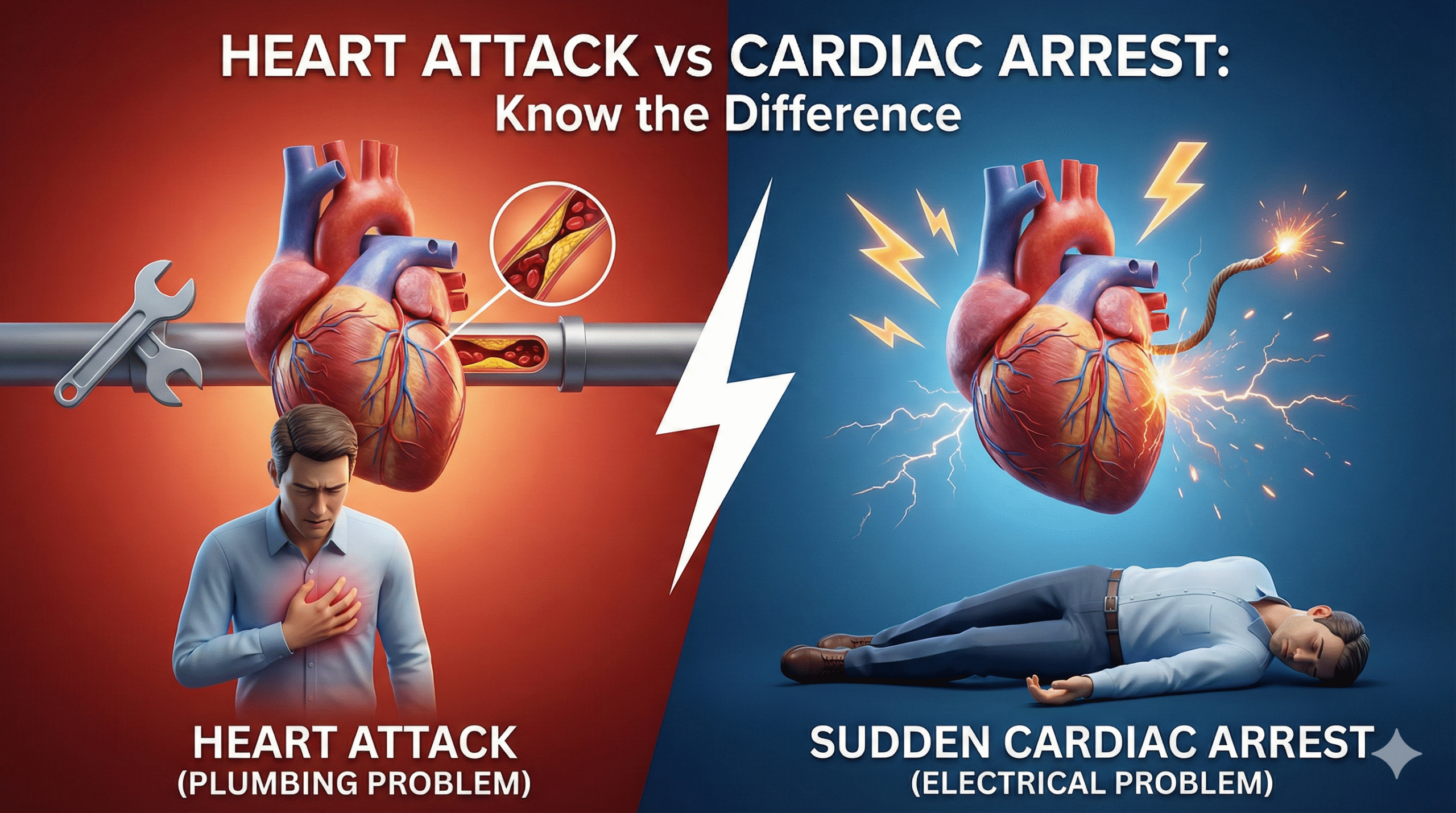
If you have heart disease, diabetes, or metabolic disorders, you are at a higher risk for both. Think of your heart as a house. A heart attack is like a plumbing problem where a pipe gets clogged. A cardiac arrest is like an electrical problem where the power suddenly goes out.
In this guide, we will break down the difference between heart attack and cardiac arrest in simple language. We will explore the symptoms, causes, and treatments so you can protect yourself and your loved ones.
Before we dive deep, here are some eye-opening facts about heart attack vs sudden cardiac arrest that might surprise you:
Survival Rates Differ: A person having a cardiac arrest can die within minutes. Only 10% survive outside a hospital. However, with immediate CPR, survival chances jump to 90%.
The “Silent” Problem: More than 50% of cardiac arrest cases happen in people who had no previous symptoms of heart disease.
Time is Muscle: For heart attacks, treatment should ideally begin within 90 minutes to save the heart muscle.
Women are Different: Women often experience unusual tiredness, nausea, and back pain instead of the classic chest pain during a heart attack.
The Connection: While they are different, a heart attack leading to cardiac arrest is possible if the attack is severe and untreated.
A heart attack, medically known as myocardial infarction, happens when blood flow to a part of the heart is blocked. This is a circulation problem.
Imagine a garden hose that gets kinked. Water stops flowing, and the plants beyond the kink start to wither. Similarly, in a heart attack, a blocked artery prevents oxygen-rich blood from reaching the heart muscle.
If the blocked artery is not opened quickly, that part of the heart muscle begins to die. The longer the blockage lasts, the greater the damage. However, during a heart attack, the heart usually keeps beating.
What happens during a cardiac arrest is very different. Sudden cardiac arrest is an electrical malfunction.
Your heart has an internal electrical system that controls the rhythm of your heartbeat. In cardiac arrest, this system goes haywire. The heart stops pumping blood to the brain, lungs, and other organs.
Instead of a steady beat, the heart may quiver uselessly or stop completely. The person collapses and loses consciousness within seconds. This is an immediate crisis where the “lights go out” instantly.
To understand the heart attack vs sudden cardiac arrest difference, you must look at the cause.
Heart Attack: This is a blocked artery vs electrical heart problem. It is caused by a physical blockage (plaque or clot) in the blood vessels.
Cardiac Arrest: This is purely an electrical failure. The heart’s rhythm becomes chaotic, leading to a complete stop.
A Harvard study emphasizes that knowing this distinction is crucial for the right emergency response. A heart attack victim is usually awake and talking. A cardiac arrest victim is unconscious and not breathing.
Recognizing the symptoms of heart attack vs cardiac arrest can help you act fast. The signs are very different.
Heart attack and cardiac arrest symptoms for a heart attack usually develop slowly over minutes or hours. Common signs include:
Chest pain or pressure (squeezing feeling).
Pain spreading to the arm, neck, jaw, or back.
Shortness of breath and cold sweats.
Note for Diabetics: If you have diabetes, you might have a “silent” heart attack with no chest pain, just fatigue or nausea.
Cardiac arrest happens instantly. There is often no warning.
Sudden collapse.
No pulse and no heartbeat.
No breathing or gasping for air.
Complete loss of consciousness.
The cardiac arrest vs heart attack causes are distinct, though they share some risk factors like smoking, obesity, and diabetes.
The main cause is coronary artery disease. Fatty deposits called plaque build up in the arteries. If a plaque ruptures, a blood clot forms and blocks the flow. This is common in people with high cholesterol and high blood pressure.
The causes of sudden cardiac arrest are related to the heart’s rhythm. The most common cause is ventricular fibrillation (a chaotic rhythm). Other causes include:
Thickened heart muscle (cardiomyopathy).
Previous heart attack scarring.
Electrical abnormalities present from birth.
Severe physical stress or trauma.
It is important to note that cardiac arrest without heart attack is very possible. You can have clean arteries but still suffer an electrical failure due to genetic issues or electrolyte imbalances.
Yes, a heart attack leading to cardiac arrest is a dangerous possibility.
When a heart attack damages the heart muscle, it can disrupt the electrical signals. This instability can trigger the dangerous rhythms that cause cardiac arrest.
This is why doctors say “Time is Muscle.” Treating a heart attack quickly prevents the damage that could lead to cardiac arrest later.
Many patients ask, is cardiac arrest worse than heart attack? In terms of immediate danger, yes.
Cardiac arrest leads to death within minutes if not treated. The heart attack vs cardiac arrest survival rate reflects this urgency.
Heart Attack Survival: About 90% of patients survive if they reach the hospital.
Cardiac Arrest Survival: Only about 10% survive if it happens outside a hospital.
However, if CPR and defibrillation for cardiac arrest are performed immediately, survival rates can increase to 70-90%.
Understanding the statistics of heart attack vs sudden cardiac arrest helps us see the scale of the problem.
In India, cardiac arrest causes over 700,000 deaths annually.
3 million people suffer heart attacks each year.
Heart attacks in Indians often happen 10 years earlier than in Western populations.
The emergency response for cardiac arrest is different from a heart attack. Knowing what to do can save a life.
Call Emergency Services (108) immediately.
Keep the person calm and seated.
Give Aspirin (chewable) if they are not allergic. This helps thin the blood.
Do not leave them alone.
Call Emergency Services immediately.
Start CPR right away. Push hard and fast in the center of the chest.
Use an AED (Defibrillator) if available. It sends a shock to reset the heart rhythm.
Do not stop CPR until help arrives.
Here is a simple table to compare the myocardial infarction vs cardiac arrest treatments and features.
| Feature | Heart Attack (Plumbing) | Sudden Cardiac Arrest (Electrical) |
| Main Problem | Blocked blood flow | Electrical malfunction |
| Consciousness | Patient is usually awake | Patient is unconscious |
| Breathing | Breathing, but difficult | No breathing |
| Heartbeat | Continues beating | Stops or quivers |
| Immediate Action | Call Ambulance, Aspirin | CPR, Defibrillator (AED) |
| Survival Time | Hours without treatment | Minutes without treatment |
| Hospital Treatment | Angioplasty, Stents, Meds | Resuscitation, ICD Implant |
The conventional approach to heart attack vs sudden cardiac arrest involves modern medical procedures.
For Heart Attack: Doctors use angioplasty (balloons) and stents to open blocked arteries. Medications like blood thinners are also standard.
For Cardiac Arrest: After restarting the heart, doctors may implant a device called an ICD. This device monitors the heart and shocks it if it stops again.
For patients who are recovering from a heart attack or have chronic heart failure, EECP Therapy (Enhanced External Counterpulsation) is a powerful tool.
EECP is a non-invasive treatment that acts like a “natural bypass”. It involves cuffs on the legs that inflate and deflate to improve blood flow to the heart.
Benefits of EECP:
It is safe for patients who cannot have surgery.
It reduces chest pain and improves energy.
It helps develop new small blood vessels, improving circulation naturally.
While emergency care is vital for heart attack vs sudden cardiac arrest, natural remedies can support long-term prevention. Note: Always consult your doctor before trying these.
Arjuna (Ayurvedic): Known as a heart tonic, it strengthens heart muscles and helps with circulation.
Ashwagandha: Helps reduce stress, which is a key risk factor for heart issues.
Homeopathy: Remedies like Crataegus (for heart weakness) and Arnica (for trauma) are used as supportive care under professional guidance.
Natural Foods: Omega-3 from flaxseeds and garlic can help lower blood pressure and cholesterol.
If you have diabetes or metabolic disorders, preventing heart attack vs sudden cardiac arrest requires extra care. High blood sugar damages blood vessels and nerves.
Control Sugar Levels: Keeping diabetes in check protects your heart’s nerves and arteries.
Watch for Silent Signs: Be aware that your symptoms might be subtle, like fatigue or sweating.
Lifestyle Changes: Quit smoking, manage weight, and reduce salt intake.
Managing heart health doesn’t always mean surgery. NexIn Health is a leading center for heart and spine treatment using non-invasive integrated techniques.
With over 14 years of experience and having consulted more than 30,000 patients, NexIn Health specializes in helping patients with heart disease, diabetes complications, and metabolic disorders. Our expert team combines modern technology like EECP with personalized care to help you achieve optimal health without invasive procedures.
Contact Us Today:
Phone & WhatsApp: +91 9310145010
Website: www.nexinhealth.in
Email: care@nxinhealth.in
Que: Can a person having a heart attack still walk and talk?
Ans:
Yes, most heart attack victims remain conscious. They can talk and walk, although they usually feel pain and shortness of breath. This is a key difference in heart attack vs sudden cardiac arrest.
Que: How quickly does cardiac arrest kill?
Ans:
Without treatment, cardiac arrest can cause death within 4 to 6 minutes. Brain damage starts after just 3 minutes without oxygen.
Que: Can you survive a cardiac arrest on your own?
Ans:
No. A person with cardiac arrest is unconscious and needs external help like CPR and defibrillation immediately to survive.
Que: Does every heart attack lead to cardiac arrest?
Ans:
No. Most heart attacks do not lead to cardiac arrest if treated quickly. However, severe untreated attacks can trigger it.
Que: Can young people have cardiac arrest?
Ans:
Yes. In young people, causes of sudden cardiac arrest are often genetic heart defects or electrical issues, rather than blocked arteries.
Que: What is the difference between a heart attack and a stroke?
Ans:
A heart attack is a blockage in the heart. A stroke is a blockage in the brain. Both affect blood vessels but in different organs.
Que: Is chest pain always present in a heart attack?
Ans:
No, especially in women and diabetics. They may feel nausea, back pain, or extreme fatigue instead of chest pain.
Que: How effective is EECP therapy for heart patients?
Ans:
EECP is very effective. Studies show 70-80% of patients report reduced chest pain and better quality of life after treatment.
Que: Should I take aspirin if I think I am having a heart attack?
Ans:
Yes, if you are not allergic. Chewing aspirin helps reduce clotting. But call emergency services first.
Que: Can stress alone cause a heart attack or cardiac arrest?
Ans:
Chronic stress contributes to heart disease. While rare in healthy people, severe emotional stress can trigger events in those with existing heart conditions.


Experience

Certified Therapists

Satisfied Patients
Contact us