Is Chest Pain Always a Sign of Heart Attack? Cardiac vs Non-Cardiac Causes Explained?
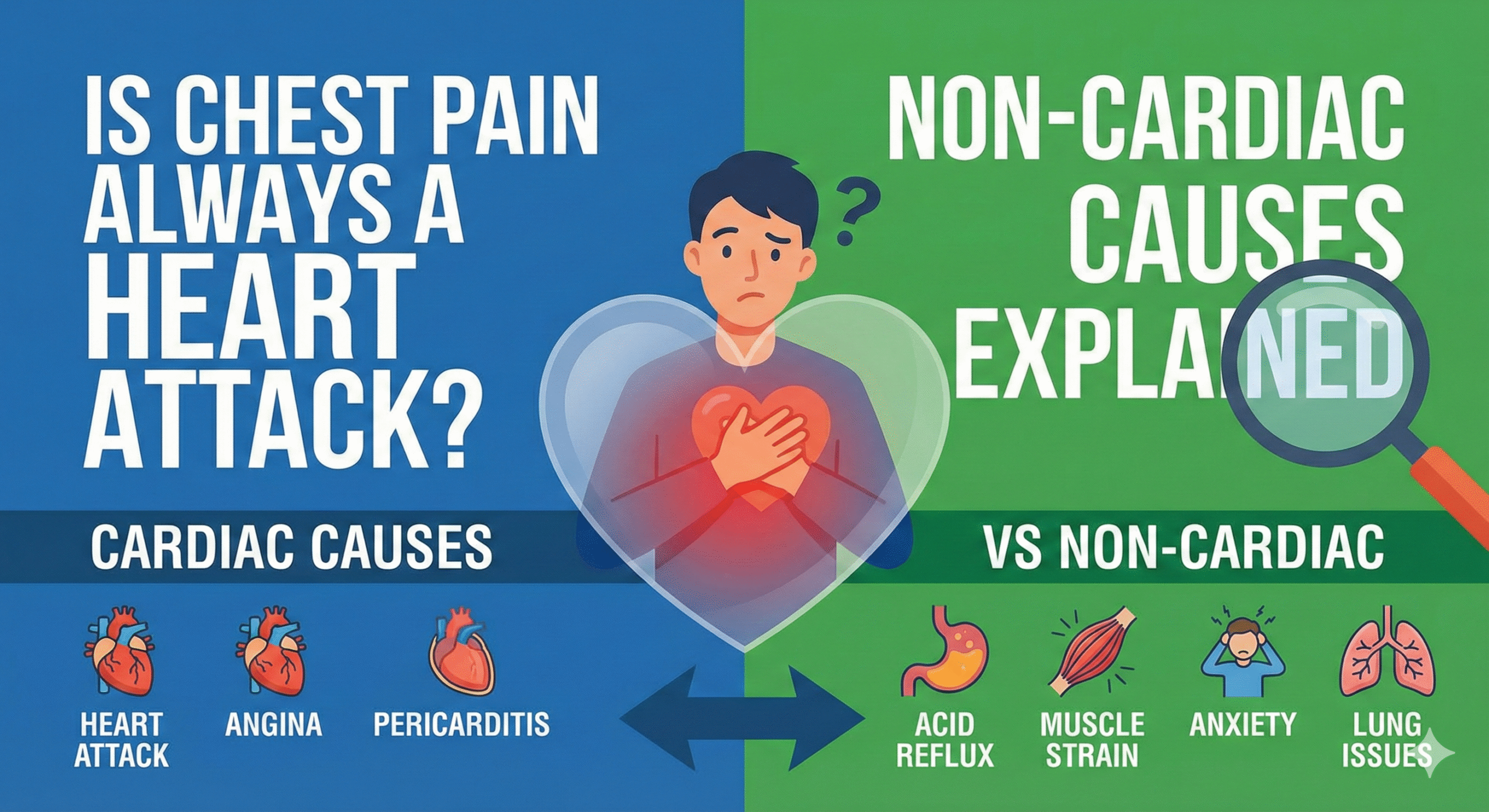



Chest pain is one of the most frightening symptoms a person can experience. The moment you feel a tightness or sharp sting in your chest, your mind likely jumps to the worst conclusion. You immediately ask yourself, “Is Chest Pain Always a Sign of Heart Attack?” This fear is natural because we have been taught that chest pain equals danger. However, the reality is more complex and often less scary than you might think.
For patients managing diabetes, high blood pressure, or metabolic disorders, understanding the real cause of chest pain is essential. While you should never ignore symptoms, it is comforting to know that many cases are not life-threatening. In this guide, we will explore the question: Is Chest Pain Always a Sign of Heart Attack? We will break down the differences between cardiac and non-cardiac causes, helping you understand when to relax and when to rush to the hospital.
Before we dive into the details, here are some eye-opening facts about chest pain that might surprise you:
Only 20% are Heart Attacks: Studies from emergency rooms show that out of all people admitted for chest pain, less than 20% are actually having a heart attack. The rest have issues like acidity, muscle strain, or anxiety.
The “Monday Morning” Peak: Cardiac chest pain is statistically more likely to occur on Monday mornings due to the spike in stress hormones like cortisol.
Diabetes Changes the Pain: Up to 45% of heart attacks in diabetic patients are “silent,” meaning they may not feel chest pain at all, but only breathlessness or fatigue.
The “Burning” Confusion: Severe acid reflux (GERD) can mimic a heart attack so closely that even doctors sometimes need tests to tell the difference.
Panic Attacks Mimic Heart Attacks: A panic attack can cause chest tightness, sweating, and a racing heart, which feels almost identical to a cardiac event.
To answer the question, “Is Chest Pain Always a Sign of Heart Attack?”, we must first understand what a heart attack actually feels like.
A chest pain heart attack scenario usually involves a specific type of discomfort. It is rarely a sharp, poking pain that you can pinpoint with one finger. Instead, it is often described as a heavy pressure, squeezing, or fullness. Imagine an elephant sitting on your chest. This happens because the heart muscle is crying out for oxygen due to a blocked artery.
However, the answer to “Is Chest Pain Always a Sign of Heart Attack?” is no. While the heart is a major cause, the chest contains ribs, muscles, lungs, the esophagus (food pipe), and nerves. Pain in any of these areas can feel like it is coming from the heart. For example, muscular chest pain from a heavy workout can be sharp and painful, but it is not dangerous.
Understanding this helps reduce panic. When you ask, “Is Chest Pain Always a Sign of Heart Attack?”, remember that the body has many other ways of creating chest discomfort.
One of the most common confusions for patients is the difference between gas pain and heart pain.
Acidity, gas, and heartburn are extremely common in people with metabolic disorders due to medication or diet.
Burning Chest Pain Acidity: Gas pain often manifests as a burning sensation behind the breastbone. It usually happens after a heavy meal or when lying down.
Heart Pain vs Acidity: The key difference often lies in movement. If the pain gets worse when you walk or exert yourself, it is likely your heart. If the pain gets worse when you lie flat or bends over, it is likely acidity.
So, Is Chest Pain Always a Sign of Heart Attack? Definitely not. In fact, gastrointestinal issues are one of the top reasons people visit the ER thinking they are dying. However, because the symptoms overlap, it is always safer to get checked if you are unsure.
If the answer to “Is Chest Pain Always a Sign of Heart Attack?” is no, then what else could it be? There are several causes of chest pain that have nothing to do with your heart.
Have you lifted something heavy recently? Muscular chest pain is very common. If you can press on your chest with your fingers and reproduce the pain, or if the pain changes when you twist your body, it is likely a muscle or bone issue (like Costochondritis), not a heart attack.
Mental health plays a huge role. Anxiety chest pain is real and terrifying. During a panic attack, you might hyperventilate, causing your chest muscles to tighten. You might ask, “Is Chest Pain Always a Sign of Heart Attack?” during a panic attack because your heart races, but the cause is adrenaline, not a blockage.
Problems like pneumonia or a clot in the lung (pulmonary embolism) can cause chest pain. This pain is usually sharp and gets worse when you take a deep breath.
To determine if the answer to “Is Chest Pain Always a Sign of Heart Attack?” is yes or no in your specific case, look at the pattern of the pain.
Left Arm Chest Pain: This is a classic cardiac sign. If the pain travels from your chest to your left arm, jaw, or neck, take it seriously.
Sharp Chest Pain Muscle: If the pain feels like a sudden, sharp electric shock that lasts only for a second, it is usually nerve or muscle-related.
Constant Ache: Pain that lasts for days without changing is rarely a heart attack.
Recognizing these patterns helps answer the question “is chest pain always a heart attack” for your specific situation.
While we know the answer to “Is Chest Pain Always a Sign of Heart Attack?” is negative in many cases, you must know when to worry about chest pain.
There are specific chest pain emergency signs that mean you should call an ambulance immediately:
Pressure: The pain feels like a heavy weight or squeezing.
Radiation: The pain spreads to your arms, back, neck, or jaw.
Breathlessness: You are gasping for air even while resting.
Sweating: You break out in a cold sweat accompanied by nausea.
Duration: The discomfort lasts more than 5 minutes.
If you experience these, do not pause to ask “Is Chest Pain Always a Sign of Heart Attack?”—just go to the hospital. It is better to be safe.
When you arrive at the hospital asking, “Is Chest Pain Always a Sign of Heart Attack?”, doctors follow a strict protocol called differential diagnosis chest pain.
The first test is an ECG (Electrocardiogram). It records the electrical activity of your heart. An abnormal ECG is a strong indicator of a heart issue.
Doctors will do a blood test to check for Troponin. This is a protein released into the blood only when heart muscle is damaged. If your Troponin levels are normal, the answer to “Is Chest Pain Always a Sign of Heart Attack?” is likely no.
The doctor will listen to your lungs and press on your chest. If pressing causes pain, it points to muscular chest pain.
For diabetic patients, the question “Is Chest Pain Always a Sign of Heart Attack?” is tricky because they might not feel pain at all.
High blood sugar damages nerves (neuropathy), which can mask the pain signals. A diabetic might have a “silent heart attack” where the only symptom is sudden fatigue or shortness of breath. Therefore, for diabetics, when chest pain is dangerous is not the only question; any sudden change in health should be evaluated.
Lifestyle diseases like hypertension and obesity increase the confusion. A heavy chest can come from high blood pressure alone. When you ask “Is Chest Pain Always a Sign of Heart Attack?”, consider your lifestyle. Are you a smoker? Is your cholesterol high? These factors increase the likelihood that the answer is yes.
However, stress also causes acid reflux and muscle tension. So, is chest pain always a heart attack in stressed individuals? Often, it is a mix of anxiety and acidity.
If you have been diagnosed with non-emergency chest pain (angina) due to heart disease, you might be looking for solutions to prevent a future attack.
EECP (Enhanced External Counterpulsation) is a non-invasive treatment known as a “Natural Bypass.” It is perfect for patients who constantly worry, “Is Chest Pain Always a Sign of Heart Attack?” whenever they feel a twinge. EECP uses cuffs on the legs to pump blood back to the heart, helping to grow new blood vessels and bypass blockages naturally.
Many patients wonder if they need surgery for their chest pain. Here is a comparison to help you understand your options.
| Parameter | EECP Therapy (Natural Bypass) | Angioplasty (Stent Surgery) |
| Invasiveness | Non-Invasive (No cuts, no needles) | Invasive (Catheter inserted in body) |
| Pain Level | Painless therapy | Mild to moderate discomfort |
| Recovery | Immediate (No downtime) | Weeks of rest required |
| Risk | Zero to minimal risk | Risk of bleeding, clots, infection |
| Mechanism | Improves natural blood flow globally | Mechanically opens a single blockage |
| Cost | Cost-effective | Expensive procedure |
| Hospital Stay | No admission needed | Requires hospitalization |
If you are constantly worrying, “Is Chest Pain Always a Sign of Heart Attack?”, let us help you find the real cause of chest pain.
NexIn Health is a leading expert in Heart and Spine Treatment with Non-Invasive Integrated Techniques. We specialize in diagnosing and treating heart conditions without surgery. With over 14+ Years of Experience and having Consulted Over 30,000 patients, we can guide you to better heart health.
Phone & WhatsApp: +91 9310145010
Website: www.nexinhealth.in
Email: care@nxinhealth.in
Contact us today to stop the worry and start the healing.
In summary, to the question “Is Chest Pain Always a Sign of Heart Attack?”, the answer is a clear no. Most chest pain is caused by gas, muscle strain, or anxiety. However, because the heart is such a vital organ, you must be vigilant.
Learn the difference between gas pain and heart pain. Recognize the chest pain emergency signs. By understanding the causes, you take control of your fear. Next time you feel a twinge, you won’t panic and ask, “Is Chest Pain Always a Sign of Heart Attack?”—instead, you will assess your symptoms calmly and take the right action.
Que:
Is Chest Pain Always a Sign of Heart Attack if it happens on the left side?
Ans:
No, not always. While heart pain is often on the left, muscular chest pain or gas can also occur on the left side.
Que:
What is the main difference between gas pain and heart pain?
Ans:
Gas pain often feels like burning and improves with burping or antacids. Heart pain feels like pressure and does not improve with burping.
Que:
Can anxiety chest pain feel like a heart attack?
Ans:
Yes, absolutely. Anxiety can cause sharp pain, palpitations, and shortness of breath, closely mimicking a cardiac event.
Que:
What does burning chest pain acidity indicate?
Ans:
It usually indicates acid reflux or GERD. If the burning moves up your throat and gets worse when lying down, it is likely acidity.
Que:
Is Chest Pain Always a Sign of Heart Attack if it lasts for hours?
Ans:
Usually, heart attack pain is intense and lasts for more than 5-10 minutes but not necessarily for hours on end without other symptoms. Constant low-grade pain is often muscular.
Que:
How does a troponin test chest pain help?
Ans:
Troponin is a protein found in heart muscles. It only enters the bloodstream if the heart is damaged. A negative test usually rules out a heart attack.
Que:
What are the chest pain emergency signs I should look for?
Ans:
Look for crushing pressure, pain radiating to the left arm or jaw, sweating, nausea, and severe breathlessness.
Que:
Why do I get sharp chest pain muscle spasms?
Ans:
This is often due to inflammation of the cartilage joining your ribs (costochondritis) or straining a muscle during exercise.
Que:
Is Chest Pain Always a Sign of Heart Attack in diabetic patients?
Ans:
Diabetics may not feel chest pain at all. They might just feel tired or breathless. So, lack of pain doesn’t mean “no heart attack” for them.
Que:
Does left arm chest pain always mean heart trouble?
Ans:
It is a strong indicator, but neck or shoulder injuries can also cause referred pain to the arm. However, always treat it as an emergency until proven otherwise.


Experience

Certified Therapists

Satisfied Patients
Contact us