Mini Heart Attack (NSTEMI): Symptoms, Risks, and Treatment Explained


Mini Heart Attack (NSTEMI): Symptoms, Risks, and Treatment Explained
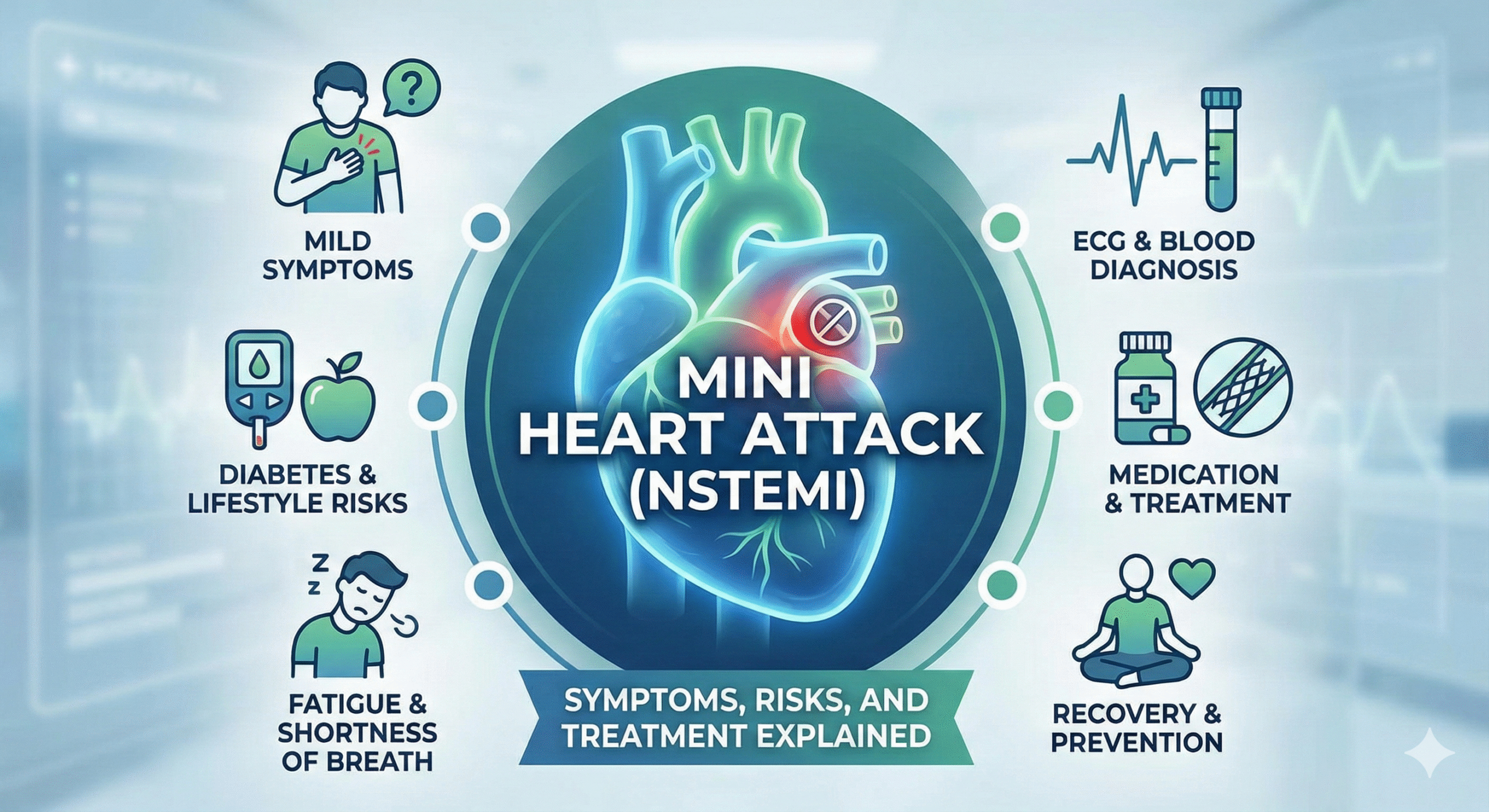
Mini heart attack (NSTEMI) is a term many people use, but few understand the real danger behind it. If you or a loved one are managing diabetes, high blood pressure, or metabolic disorders, understanding this condition is critical. It is often a final warning sign from your body that your heart needs immediate help.
While the name suggests it is “small,” a mini heart attack is a serious medical emergency. It indicates that blood flow to your heart is struggling, and without proper care, it can lead to severe heart failure. This guide explains everything you need to know in simple English, helping you spot the signs early and choose the right path to recovery.
Before we dive deep, here are some eye-opening facts about **mini heart attack (**NSTEMI) that might surprise you:
It’s Not Just “Gas”: Almost 50% of people confuse mild heart attack signs with indigestion or acid reflux, delaying treatment.
The “Silent” Threat for Diabetics: People with diabetes are twice as likely to have “silent” attacks. High blood sugar damages nerves, masking the pain, so you might not feel chest pressure at all.
Women Are Different: Women are less likely to have crushing chest pain. Instead, they often feel extreme tiredness, jaw pain, or nausea.
The “Invisible” Attack: You cannot always spot this condition on a standard heart graph. Doctors often rely on a cardiac troponin test (a blood test) because ECG changes in NSTEMI can be very subtle or invisible.
It Can Happen at Rest: Unlike massive heart attacks triggered by heavy exercise, a **mini heart attack (NSTEMI) often happens while you are sitting quietly or sleeping.
A mini heart attack (technically called NSTEMI) occurs when the blood supply to a part of the heart is restricted but not completely cut off.
STEMI: This is a “massive” attack where the artery is 100% blocked.
NSTEMI: This is a partial blockage heart attack. The artery is severely narrowed by plaque (cholesterol and fat) or a small clot, letting only a tiny amount of blood through.
Even though the blockage isn’t total, heart cells begin to die from a lack of oxygen. This is why the term “mini” is misleading—permanent damage is still happening. For patients with coronary artery disease, this is a major red flag that a complete blockage could happen soon.
Recognizing mini heart attack symptoms early is the key to survival. Because the artery is not fully blocked, the symptoms might come and go, making them easy to ignore.
Common symptoms include:
Mild chest pain heart attack sensation: Feeling pressure, squeezing, or a “tight band” around the chest.
Radiating Pain: Discomfort spreading to the left arm, neck, jaw, or upper back.
Shortness of breath heart attack sign: Feeling winded even while sitting still.
Cold Sweats: Breaking out in a sweat for no reason.
Nausea: Often mistaken for a stomach bug.
For patients with metabolic disorders or diabetes, the warning signs are even quieter. Silent heart attack symptoms often include:
Sudden, unexplained fatigue (feeling drained of energy).
Mild dizziness or lightheadedness.
A general feeling of being unwell, similar to the flu.
It is important to understand the difference between NSTEMI and STEMI to understand your treatment plan.
STEMI (ST-Elevation Myocardial Infarction): The “classic” heart attack. The artery is fully blocked. The ECG machine shows a large spike (ST-elevation), and the patient is rushed instantly for surgery.
NSTEMI (Non-ST-Elevation Myocardial Infarction): The artery is partially blocked. The ECG may look normal or show only small changes. The diagnosis is confirmed when blood tests show elevated heart damage proteins.
A mini heart attack (NSTEMI) is rarely an accident; it is usually the result of long-term lifestyle habits.
Metabolic Disorders: A combination of high blood pressure, high sugar, and excess belly fat creates inflammation that damages arteries.
Diabetes: High glucose acts like “sandpaper” inside blood vessels, speeding up coronary artery disease.
Cholesterol: LDL (bad cholesterol) builds up as plaque, narrowing the space for blood to flow.
Stress: Sudden emotional stress can cause arteries to spasm, leading to a heart attack without complete blockage.
A common question patients ask is: “Can a mini heart attack be dangerous if I feel fine afterward?”
Yes.
Even a small amount of heart muscle death weakens your heart’s pumping ability. Without treatment, NSTEMI patients have a high risk of suffering a massive, fatal heart attack within the next few months. It is not just a “health scare”—it is a medical emergency.
Since mild heart attack signs can be confusing, doctors use specific tools:
ECG (Electrocardiogram): To look for ECG changes in NSTEMI, though they are often hard to see.
Cardiac Troponin Test: This is the gold standard. When heart cells die, they release a protein called Troponin into the blood. If this level is high, it confirms a heart attack.
Angiography: A camera is inserted into the arteries to visualize the partial blockage heart attack site.
Mini heart attack treatment focuses on stabilizing the heart and preventing the clot from getting bigger.
Emergency treatment for heart attack: This includes oxygen, nitroglycerin (to open veins), and aspirin (to thin the blood).
Blood Thinners: Drugs like Heparin prevent new clots.
Beta-Blockers: These slow the heart rate to reduce the workload on the heart muscle.
Statins: High-dose medication to lower cholesterol and stabilize plaque.
Here is a comparison table to help you understand NSTEMI treatment options:
| Treatment Type | Best For | Invasive? | Recovery Time |
| Medication Management | Stable patients with minor blockages | No | Immediate |
| Angioplasty (Stent) | Significant partial blockage | Minimally Invasive | 1-2 Weeks |
| Bypass Surgery (CABG) | Multiple severe blockages | Invasive (Surgery) | 6-12 Weeks |
| EECP Therapy | Patients seeking non-surgical healing | Non-Invasive | No Downtime |
| Cardiac Rehab | Strengthening heart post-attack | Non-Invasive | Ongoing |
For many heart patients, especially those who are weak, diabetic, or afraid of surgery, EECP (Enhanced External Counterpulsation) is an excellent treatment option.
How EECP Works:
Imagine a “natural bypass.” EECP uses large blood pressure cuffs on your legs. These cuffs inflate and deflate in rhythm with your heartbeat. This action pumps oxygen-rich blood back to the heart while it is resting.
Benefits: It encourages the growth of tiny new blood vessels (collaterals) around the blocked artery.
Who is it for? It is FDA-approved for reducing chest pain (angina) and is highly effective for recovering from a mini heart attack (NSTEMI).
While medical care is primary, natural remedies can support your mini heart attack treatment plan. (Always consult your doctor first).
Arjuna Bark (Ayurveda): Known as a heart tonic, it helps strengthen heart muscles and improve pumping.
Garlic: Consuming raw garlic helps reduce artery stiffness and lower blood pressure.
Omega-3 (Fish Oil/Flaxseeds): Reduces inflammation caused by metabolic disorders.
Homeopathic Support: Remedies like Crataegus and Arnica are sometimes used in complementary therapy to support heart function and recovery.
Recovery after NSTEMI depends on how fast you got treated. Most patients stay in the hospital for 2 to 4 days.
Once home, rest is vital. Your heart has been injured and needs time to form scar tissue and heal. Avoid heavy lifting or intense stress for at least 4 weeks.
To prevent a second attack, lifestyle changes after heart attack are non-negotiable.
Diet: Adopt a plant-based or Mediterranean diet. Cut out processed sugar—it is poison for arteries.
Movement: Start with 10 minutes of walking and build up.
Sleep: Poor sleep increases stress hormones that harm the heart.
Manage Numbers: Keep your HbA1c (sugar) and Blood Pressure strictly in the normal range.
If you have diabetes, your risk of a **mini heart attack (**NSTEMI) is double that of a non-diabetic. High blood sugar damages the inner lining of blood vessels, making them sticky. This attracts cholesterol faster. For diabetics, strict sugar control is actually a form of heart treatment.
Never drive yourself to the hospital if you suspect heart attack warning signs.
If you feel shortness of breath heart attack symptoms or chest pressure that lasts more than 5 minutes, call an ambulance. Paramedics can start emergency treatment for heart attack on the way to the hospital, which saves heart muscle.
Recovering from a heart event can be scary, but you don’t have to do it alone.
NexIn Health is a leading healthcare provider specializing in Heart and Spine Treatment using advanced Non-Invasive Integrated Techniques. We focus on reversing lifestyle diseases and improving heart function naturally.
Experience: 14+ Years of Excellence.
Trust: Successfully consulted and treated over 30,000 patients.
Specialty: We help patients avoid unnecessary surgeries through holistic care and advanced therapies like EECP.
Get in Touch for a Consultation:
📞 Phone / WhatsApp: +91 9310145010
🌐 Website: www.nexinhealth.in
📧 Email: care@nxinhealth.in
Que: What is the main cause of a mini heart attack?
Ans: The main cause is coronary artery disease, where plaque buildup partially blocks the blood flow to the heart, often worsened by diabetes and high blood pressure.
Que: Can a mini heart attack (NSTEMI) heal on its own?
Ans: No. The heart muscle damage is permanent. However, with proper treatment and lifestyle changes, the remaining heart muscle can compensate, allowing you to live a normal life.
Que: How long does a mini heart attack last?
Ans: Symptoms can be intermittent. You might feel chest pain or shortness of breath for 10-15 minutes, which goes away and comes back. Unlike a massive attack, the pain isn’t always constant.
Que: Is a mini heart attack visible on an ECG?
Ans: Not always. ECG changes in NSTEMI can be very subtle. This is why doctors rely on the cardiac troponin test to confirm if heart damage has occurred.
Que: What is the best diet for recovery?
Ans: A low-sodium, low-sugar diet is essential. Focus on fiber-rich foods like oats, vegetables, and fruits to help lower cholesterol naturally.
Que: Can stress cause a mini heart attack?
Ans: Yes. Severe emotional stress can cause a temporary spasm in the arteries, cutting off blood flow even if your arteries aren’t fully blocked by plaque.
Que: Is EECP therapy safe for NSTEMI patients?
Ans: Yes, EECP is a very safe, FDA-approved non-invasive therapy. It is excellent for patients recovering from NSTEMI to improve blood flow without surgery.
Que: What are the silent symptoms for diabetics?
Ans: Diabetics often miss mild heart attack signs due to nerve damage. Look out for sudden exhaustion, breathlessness without exertion, and mild nausea.
Que: How soon can I exercise after a mini heart attack?
Ans: You should start slowly. Walking is usually permitted after discharge, but intense exercise should only be done under a doctor’s supervision or in cardiac rehab.
Que: What is the difference between Angina and NSTEMI?
Ans: Angina is temporary pain with no permanent damage. A **mini heart attack (**NSTEMI) involves actual death of heart tissue and requires urgent medical care.


Experience

Certified Therapists

Satisfied Patients
Contact us