Top Heart Attack Research Breakthroughs of 2025: What Patients Should Know


Top Heart Attack Research Breakthroughs of 2025: What Patients Should Know
Heart Attack Research Breakthroughs of 2025 are reshaping how we understand, detect, and treat the world’s leading cause of death. For millions of patients navigating life with heart disease, diabetes, or metabolic disorders, the medical landscape has often felt like a maze of complex terms and invasive procedures. However, this year marks a turning point. We are moving from a reactive model—treating heart attacks after they happen—to a proactive era of prediction, precision, and non-invasive reversal.
In 2025, science has finally caught up with the body’s natural rhythms and healing capabilities. From artificial intelligence that can “hear” silent heart murmurs to gene therapies that edit cholesterol out of your DNA, the future is here. But perhaps most importantly, research this year has validated that you have more control than you think. Whether it is through advanced non-surgical therapies like EECP or understanding the dangerous “winter morning” phenomenon, the power to protect your heart is increasingly in your hands.
This comprehensive report is designed for you—the patient, the caregiver, the survivor. We have stripped away the confusing medical jargon to bring you a clear, research-backed guide to the most critical Heart Attack Research Breakthroughs of 2025.
Before we dive into the deep science, let’s look at the numbers. The following facts, drawn from the latest cardiovascular research highlights of 2025, might surprise you. These statistics are not just numbers; they are warning signs and opportunities for better health.
One of the most practical Heart Attack Research Breakthroughs of 2025 is not a new drug, but a deeper understanding of when and why heart attacks happen. By understanding the biological clock of your heart, you can take simple steps to protect it.
You might wonder, “Why is the morning so dangerous?” When you wake up, your body needs to shift from a resting state to an active one. To do this, it releases a cocktail of hormones:
For a healthy person, this is normal. But for a patient with heart disease or diabetes, whose arteries might already be narrowed by plaque, this sudden morning surge can cause a blockage to rupture, leading to a heart attack.
When you add cold weather to the morning mix, the risk multiplies. This is a critical area of winter heart attack risk research.
Based on these heart disease research updates:
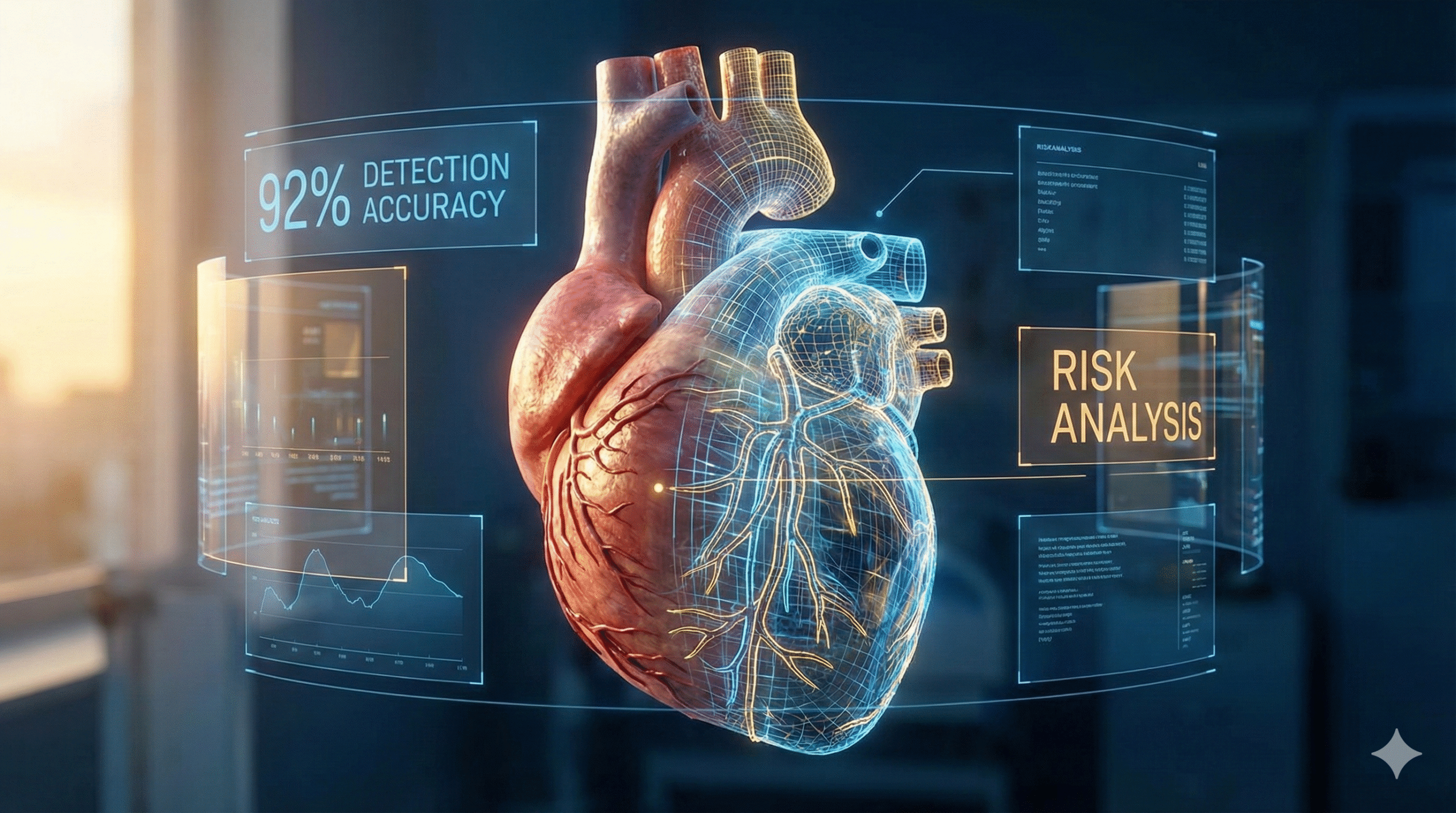
Artificial Intelligence (AI) is no longer just for tech companies; it is saving lives in the emergency room. AI in heart disease diagnosis has made a massive leap in 2025, acting as a “super-doctor” that sees things human eyes miss.
For decades, doctors have relied on the standard 12-lead ECG (the sticky patches on your chest) to diagnose heart attacks. The problem? Human doctors sometimes miss subtle signs, especially in complex cases.
In 2025, a groundbreaking study presented at the TCT conference introduced the “Queen of Hearts” AI algorithm. This AI was trained on thousands of heart scans to spot silent heart attack detection signals.
The stethoscope has been used for 200 years, but it has a flaw: it relies on the doctor’s hearing. New research published in JACC: Advances highlights AI-based stethoscopes that can “listen” to your heart and diagnose valve disease with incredible accuracy.
If you have high blood pressure or cholesterol that just won’t come down, 2025 has brought hope. New heart medications 2025 are targeting the specific biological mechanisms that cause disease, rather than just treating symptoms.
Do you take three or four pills for blood pressure, but it is still high? You might have “resistant hypertension.” Often, this is caused by a hormone called aldosterone.
Imagine if you didn’t have to remember a daily pill. Zilebesiran is a revolutionary RNA interference therapy.
Patients with atrial fibrillation (irregular heartbeat) or past strokes often take blood thinners. The biggest fear with these drugs is dangerous bleeding.
Heart Attack Research Breakthroughs of 2025 have moved into the realm of science fiction becoming fact. We are now able to “edit” the genes that cause heart disease.
High cholesterol is the primary driver of blockages. For some, this is genetic (Familial Hypercholesterolemia).
Heart failure happens when the heart muscle becomes weak and disorganized. New research published in npj Regenerative Medicine focused on a gene therapy called cBIN1.
The watch on your wrist is becoming a medical device. Wearable heart monitoring technology trends in 2025 are focused on accuracy and early warning.
For years, measuring blood pressure meant squeezing your arm with a cuff. In 2025, we are seeing the rise of “cuffless” monitoring.
These tools are powerful for heart health trends 2025 monitoring, putting data in your pocket.
When you are diagnosed with a blockage, the decision of how to treat it can be terrifying. Should you have a stent? A bypass? Or is there another way? New findings in heart care emphasize that for stable patients, invasive surgery is not always the best first choice.
Below is a detailed comparison of the three main treatment paths, including the non-invasive EECP Therapy.
| Feature | Angioplasty (Stenting) | Bypass Surgery (CABG) | EECP Therapy (Natural Bypass) |
| What is it? | A balloon and metal mesh (stent) are inserted via a catheter to prop open a blocked artery. | Major open-heart surgery using a vein from the leg to create a detour around blockages. | Non-invasive therapy using pressure cuffs on legs to pump blood and grow new vessels. |
| Invasiveness | Minimally Invasive (Catheter via wrist/groin). | Highly Invasive (Chest bone cut, heart-lung machine). | Zero Invasiveness (External cuffs only). |
| Recovery Time | 1-2 weeks. | 6-12 weeks (Long, painful recovery). | None (Walk out immediately after session). |
| Risk | Bleeding, kidney damage from dye, stent clotting. | Infection, stroke, “pump head” (cognitive decline). | Extremely safe; minor skin irritation possible. |
| Mechanism | Treats a single blockage spot mechanically. | Bypasses the specific blocked area surgically. | Treats the whole heart by stimulating natural collateral vessels. |
| Best For | Acute Heart Attacks (Emergencies). | Multiple blockages, complex diabetic disease. | Chronic angina, heart failure, patients unfit for surgery, prevention. |
| Diabetes Impact | High risk of re-blocking (restenosis) in diabetics. | Better survival than stents for diabetics, but high surgical risk. | Improves blood sugar control and circulation in small vessels. |
Table Data Source:
Included in the advances in heart attack prevention is a therapy that requires no surgery, no cutting, and no hospitalization: Enhanced External Counterpulsation (EECP).
Often called a “Natural Bypass,” EECP is an FDA-approved therapy. You lie on a comfortable bed, and a series of pneumatic cuffs are wrapped around your calves, thighs, and buttocks. These cuffs inflate and deflate in perfect sync with your heartbeat, controlled by a computer.
With the rising costs and risks of surgery, EECP is gaining ground as a powerful tool for reducing heart attack recurrence. It is particularly beneficial for diabetic patients who often have “diffuse” disease—blockages in tiny vessels that are too small for stents to reach. By increasing blood flow, EECP stimulates the body to grow new, tiny blood vessels (collaterals) around the blockages, naturally restoring flow.
Alongside new heart medications 2025, nature offers potent allies. Latest scientific advances in heart attack treatment have validated several traditional remedies with rigorous testing.
Arjuna is a tree bark used in Ayurveda for centuries. Modern research in 2025 confirms it is a powerful cardioprotective agent.
Garlic is a therapeutic powerhouse, but you need the right kind (often aged garlic extract).
Hawthorn is being studied for its ability to dilate (widen) blood vessels and improve blood flow.
It is not just what you take, but what you do. Studies presented in 2025 highlight that Yoga significantly reduces adverse cardiovascular events.
Can you eat your way out of heart disease? New studies on diet and heart disease reversal in 2025 say “Yes.”
Research continues to support approaches like the Ornish or Nutritarian diets. These are not just “eating healthy”—they are strict interventions.
Heart health trends 2025 are focusing heavily on what happens when you close your eyes.
New research published in the journal Sleep suggests that “catching up” on sleep over the weekend might actually lower the risk of calcium buildup in heart arteries.
Chronic stress is a poison to the heart. It keeps cortisol levels high, which damages arteries over time. The “Monday Effect” we mentioned earlier is proof of this. Managing stress through meditation, yoga, or simply deep breathing is not a luxury—it is a medical necessity for advances in heart attack prevention.
Navigating heart disease, diabetes, or metabolic disorders requires an expert team that understands both modern technology and holistic healing. You don’t have to choose between science and nature—you can have both.
NexIn Health is a pioneer in Non-Invasive Integrated Healthcare. With over 14 years of experience and having consulted over 30,000 patients, we specialize in treating the root cause of heart and spine conditions without surgery.
We combine FDA-approved therapies like EECP with nutritional science, Ayurveda, and lifestyle management to help you reclaim your life. We believe in treating the patient, not just the report.
Don’t wait for a crisis. Call us to learn how we can help you prevent and reverse heart disease naturally with our proven, non-surgical methods.
Que: What are the main Heart Attack Research Breakthroughs of 2025 I should ask my doctor about?
Ans: You should ask about new medications like Baxdrostat for resistant blood pressure, the availability of AI-enhanced screening for hidden heart risks, and non-invasive options like EECP therapy if you have angina.
Que: How does the “Morning Heart Attack” risk affect my daily routine?
Ans: Since risk is highest between 6 AM and 9 AM, avoid heavy exertion immediately after waking. Take your blood pressure medications as prescribed (some doctors recommend taking them at night to cover the morning surge) and stay warm during winter mornings.
Que: Is EECP therapy safe for patients with diabetes and stents?
Ans: Yes, EECP is FDA-approved and is considered a “natural bypass.” It is particularly effective for diabetic patients who may have small vessel disease that stents cannot fix. It is non-invasive and safe for patients who have already had stents.
Que: Can wearable tech really detect a heart attack before it happens?
Ans: While wearables like the Apple Watch can detect irregular rhythms (AFib) and high blood pressure trends which are risk factors, they cannot currently detect a heart attack in progress (like a blocked artery) with certainty. However, AI analysis of medical ECGs is getting much better at this.
Que: I have heard about gene therapy for cholesterol; is it available now?
Ans: Gene editing (CRISPR) for cholesterol is currently in advanced clinical trials as of 2025. While promising for a permanent cure, it is not yet widely available at local pharmacies but may be an option through clinical trial enrollment.
Que: What are the best natural supplements for heart blockage?
Ans: Research supports Terminalia Arjuna for strengthening heart muscle and Garlic extract for reducing cholesterol and plaque stability. Always consult your cardiologist before starting supplements to avoid interactions with blood thinners.
Que: Why is winter dangerous for heart patients?
Ans: Cold weather causes your blood vessels to constrict (tighten) to preserve body heat. This raises blood pressure and forces the heart to pump harder. Combined with thicker blood in the morning, this significantly increases heart attack risk.
Que: What is the difference between a silent heart attack and a regular one?
Ans: A “silent” heart attack (Silent Ischemia) has no chest pain. Symptoms might be vague, like fatigue, shortness of breath, or mild nausea. AI tools are becoming essential to detect the damage these attacks leave on the heart.
Que: Can diet really reverse heart disease?
Ans: Yes. Research (like the Ornish or Nutritarian approach) shows that a strict diet low in processed fats and high in plant-based nutrients can shrink plaque, reduce inflammation, and improve blood flow, effectively reversing the progression of the disease.
Que: How do I know if I need Angioplasty or if I can try EECP?
Ans: Angioplasty is usually required for unstable or acute emergencies (heart attacks). For chronic stable angina (chest pain during activity), trials like ISCHEMIA suggest that medication and therapies like EECP can be as safe as surgery. A consultation with an integrated heart specialist (like at NexIn Health) can help you decide.


Experience

Certified Therapists

Satisfied Patients
Contact us