The Shocking Truth of Heart Surgery: The Real Stories Doctors Rarely Tell


Patients and their families often find it hard to talk about the truth of heart surgery. Fear takes over when a doctor says there is a blockage in the heart. You might think that the only way to live through a heart attack is to have surgery. But for a lot of people with stable heart disease, diabetes, or metabolic disorders, the truth is different. Is the procedure always a life-saver, or are patients getting stuck in a “heart trap” where they have to have the same treatment over and over?
To talk about the Truth of Heart Surgery, we need to look at what happens inside the body. Traditional medicine is all about plumbing or cleaning out the pipes. The human body is a biological system, though.
People often forget important facts about heart surgery when they are in a hurry. Emergency surgery during a severe heart attack can save your life, but elective surgery for stable angina (chest pain) is up for debate. The blockage is just a sign of the real disease, which is systemic inflammation and metabolic disorder.
To talk about the Truth of Heart Surgery, we need to look at what happens inside the body. Traditional medicine is all about plumbing, or cleaning out the pipes. The human body is a biological system, though.
People often forget important facts about heart surgery when they are in a hurry. Emergency surgery during a severe heart attack can save your life, but elective surgery for stable angina (chest pain) is up for debate. The blockage is just a sign of the real disease, which is systemic inflammation and metabolic disorder.
Coronary Artery Bypass Grafting (CABG) is often presented to patients as a permanent “fix” for blocked arteries, but the medical reality is far more complex. In this major open-heart procedure, surgeons harvest blood vessels—typically from the leg (saphenous vein) or chest (internal mammary artery)—and surgically attach them to the heart to bypass blockages. While this successfully reroutes blood flow and can save lives in emergencies, it is essentially a mechanical solution to a biological problem
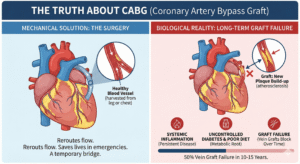
The uncomfortable truth is that CABG does not cure the underlying disease, atherosclerosis. Because the body is a systemic environment, the same process that clogged your original arteries can eventually clog the new bypass grafts. This is known as “graft failure.” Studies indicate that vein grafts, in particular, have a high failure rate, with nearly 50% becoming blocked within 10 to 15 years.
If the root causes—such as systemic inflammation, uncontrolled diabetes, and poor diet—are not addressed, the surgery becomes a temporary bridge rather than a cure. Patients who rely solely on the surgery without radically changing their lifestyle often find themselves facing recurrent issues, proving that while surgery treats the symptom, it ignores the metabolic source of the disease.
Truth of Heart Surgery that There are good and bad things about every medical procedure. To give informed consent, you need to know the risks and benefits of heart surgery.
Surgery has these benefits:
Problems with cardiac procedures:
If surgery is your only choice, getting ready for it the right way could save your life.
Truth of Heart Surgery that A lot of patients don’t realize how hard it will be to deal with what happens after heart surgery. It takes a lot of time and effort to get better, and it needs a dedicated caregiver.
The Recovery Phase After Open Heart Surgery:
The good news is that medical technology has gotten better. Most of the time, people who have open-heart surgery live. In the best hospitals, the survival rate for standard cases is over 95%. But the chance of survival goes down for people with kidney failure, diabetes that is very bad, or who are very old. The truth about heart surgery is that your overall health is more important to your survival than just the surgeon’s skill.
After heart surgery, you will need to make big changes in your life. A lot of people think that after surgery, they can eat whatever they want. This is a dangerous lie.
You must make changes to your life after heart surgery. The Truth of Heart Surgery is that you could end up on the operating table again if you start smoking, eating processed foods, or following a diet high in sugar.
We often don’t pay attention to our minds. The Truth of Heart Surgery is that It is just as hard to get over heart surgery emotionally as it is physically. A lot of people with heart problems have “Cardiac Depression.”
People who have heart surgery often feel vulnerable, have mood swings, and are afraid of having another attack. During this time, support from family is very important. Heart surgery affects everyone in the family, not just the patient.
Technology has come a long way. Minimally invasive heart surgery is a new way to do heart surgery that is less invasive than the old “zipper” method. In this case, surgeons make small cuts between the ribs instead of cutting through the breastbone.
Pros:
But not everyone can do it. The truth about heart surgery is that open-heart surgery is still needed for complicated blockages that involve more than one vessel.
In addition to bypass surgery, there are advanced cardiac procedures like robotic heart surgery and TAVR (transcatheter aortic valve replacement). These give patients who are too weak for open surgery hope.
Replacing a Heart Valve Truth: You need to fix your valves if they are broken. The truth about heart valve replacement is that you have to choose between a mechanical valve (which lasts a long time but needs blood thinners for life) and a biological valve (which comes from a pig or cow and wears out in 10 to 15 years). This choice will have a big effect on your daily life.
Heart surgery for people over 70 or 80 is riskier. Older bodies don’t have as much extra energy to recover from the heart-lung machine. Before agreeing to surgery for an older parent, look up the survival rate for open-heart surgery for people their age. Less invasive management is often a better and safer way to improve quality of life.
Let’s clear up some of the Truth of Heart Surgery
Heart surgery can be expensive and cause financial problems.
Let’s look at the choices to better understand the Truth of Heart Surgery.
| Parameter | Coronary Artery Bypass Grafting (CABG) | Angioplasty (Stents) | EECP (Natural Bypass) |
| Being invasive | High (Cut open chest) | Medium (Wire in artery) | Non-invasive (external cuffs) |
| Time to Get Better | 3 to 6 Months | One to two weeks | No downtime |
| Risk Factor | High (Stroke, Infection) | Moderate (Clotting) | Very Low / Minimal |
| Pain Level | High | Moderate | Painless |
| Anesthesia | General Anesthesia | Local Anesthesia | None |
| Best for | Multiple Severe Blocks | 1 to 2 blockages | People with angina, a weak heart, or diabetes |
Integrated medicine can help keep your heart healthy. You should talk to your doctor first, but some natural remedies can help with recovery or prevention after heart surgery.
Ayurvedic and Natural Help:
Homeopathic Help:
Is there a way to get more blood to flow without cutting the chest? Yes. EECP Therapy (Enhanced External Counter Pulsation) is a safe and effective treatment that doesn’t require surgery.
How EECP Works:
It works like a “second heart.” The cuffs on your legs fill and empty in time with your heartbeat. This makes the heart muscle get more blood and helps new, small blood vessels (collaterals) grow. It is an important part of advanced heart procedures that don’t need a knife.
Why pick EECP?
Heart surgery is not a magic wand; it is a tool. If you only rely on surgery and don’t change your way of life, you’re in a “Heart Trap.”
A full approach to healing includes a healthy diet, stress management, fixing metabolic problems, and therapies that don’t involve surgery, like EECP. Before you rush into the operating room, ask questions, get a second opinion, and look at the truth about heart surgery from all sides.
NexIn Health is India’s best place to get heart and spine treatment using cutting-edge, non-invasive, integrated technologies. We focus on holistic care to help patients avoid surgeries that aren’t necessary.
Get in touch with us today if you want to learn about safe alternatives or need help after surgery.
📞 Phone & WhatsApp: +91 9310145010
🌍 Website: www.nexinhealth.in
🌍VISIT OUR CENTER IN NOIDA- https://www.nexinhealth.in/eecp-treatment-in-noida/
📧 Email: care@nxinhealth.in
Is it true that heart surgery is always needed for blockages?
Answer: No. For patients who are stable, changes to their medication and lifestyle are often just as helpful as surgery. Surgery is necessary in most cases of heart attacks that happen suddenly.
Que: What are the most common problems that happen during cardiac procedures?
Ans: Common problems include infections, bleeding, irregular heartbeats, and changes in thinking (like memory problems).
How long does it take to recover from open heart surgery?
Answer: It takes about 6 to 8 weeks for the bone to heal physically, but it can take up to 6 months for the person to get their full energy back.
Que: How much does heart surgery in India usually cost?
Answer: The cost of bypass surgery varies, but it usually costs between ₹2.5 lakh and ₹6 lakh, depending on the hospital and how complicated the surgery is.
Que: Is it possible to do minimally invasive heart surgery on everyone?
Ans: No, it depends on where the blockages are and how many there are. Most of the time, open surgery is needed for complicated cases.
Que: What are the success rates for heart surgery in older people?
Ans: Most of the time, success rates are good, but the risk of problems like stroke and kidney failure goes up a lot as you get older.
Que: Am I cured after heart surgery?
No, it means that your blood flow is back to normal for a short time. To keep new blockages from forming, you need to take care of your diabetes and diet.
Can I use Ayurveda or Homeopathy along with treatments that are based on facts about heart surgery?
Yes, integrated medicine does help. But don’t stop taking allopathic medicines without talking to your cardiologist first.
What is the truth about the rates of failure for bypass surgery?
Answer: About half of vein grafts from legs fail within 10 to 15 years. Arterial grafts last longer.
Que: Is EECP a safe option that Advanced Cardiac Procedures talks about?
Yes, EECP is FDA-approved, non-invasive, and very effective for people who can’t or don’t want to have surgery.


Experience

Certified Therapists

Satisfied Patients
Contact us