


NexIn Health - Integrated Health Centre
At NexIn Health, we take pride in being a trusted name in Enhanced External Counterpulsation (EECP) treatment across India. Renowned for our commitment to excellence, NexIn Health is a leading organisation dedicated to providing innovative, non-invasive cardiac care solutions (EECP Therapy in India) and Chelation Therapy in India. Our team comprises highly skilled doctors and healthcare professionals who specialise in delivering cutting-edge heart care through Integrated Therapies EECP therapy, Chelation Therapy, DETOX Therapies, and Other Non – non-invasive treatments, ensuring personalised and effective treatment for every patient.
With a focus on pioneering advancements in non-invasive cardiology, NexIn Health (EECP Treatment and Chelation Therapy in India) is redefining heart care by combining expertise, technology, and compassion. Whether you’re seeking preventive care or advanced treatment, we are here to support your journey toward better heart health. Discover the future of integrated healthcare with NexIn Health – where innovation meets care.
EECP Treatment After Angioplasty Recovery: A Complete Guide to Healing Your Heart Without Surgery
After getting a stent put in, your journey to a healthy heart doesn’t end right away. For a lot of patients, EECP Treatment After Angioplasty Recovery is the “missing piece” that makes sure they stay healthy for a long time. Angioplasty is great for opening a blocked artery, but it doesn’t always help the smaller blood vessels get better. This is where EECP Therapy for After Angioplasty Recovery comes in to help get the heart back to normal.
Even after a successful procedure, a lot of people still feel tired or have mild chest pain. EECP is a non-surgical treatment that can help fill this gap after angioplasty. It acts like a “natural bypass,” telling the body to make new routes for blood to flow. This complete guide will explain why EECP After Angioplasty Recovery is becoming the best choice for people who want to stay active and pain-free without having to have more surgery.
Major health organisations around the world, such as the FDA, have approved this therapy, and top cardiologists use it all over the world. People with coronary artery disease, persistent angina, or those who want to get the most out of their post-angioplasty cardiac rehabilitation will find it especially helpful. It helps the heart heal faster and stronger than with medication alone by improving blood flow throughout the body.
Conditions Treated by EECP
| Condition | Description |
|---|---|
| Chronic Stable Angina | Persistent chest pain due to reduced blood flow to the heart 💔 |
| Small Vessel Disease | Heart disease affecting small blood vessels that are hard to treat 🕸️ |
| Heart Failure | Heart failure with fluid congestion and reduced pumping ability 🫀 |
| Post-Stent Blood Flow Issues | Poor or uneven blood flow even after stent placement 💉 |
| Low Stamina & Fatigue | Tiredness and reduced stamina due to weak heart circulation 🔋 |
Key Statistics Regarding EECP Treatment Following Angioplasty Recovery
| Type | Data / Stat |
|---|---|
| Recurrence Rate | About 20–30% of patients experience chest pain again within one year after stent placement. |
| EECP Success Rate | More than 80% of patients report a significant improvement in symptoms after EECP therapy. |
| Duration of Benefits | The positive effects of one full EECP treatment course can last for three to five years. |
| Global Approval | Approved by the FDA (USA) and supported by the NHS (UK) for chronic stable angina. |
Information on Diagnosis and Prevalence
-
Persistent Angina: About 25% of people who have angioplasty still have “refractory angina,” which means that medicine doesn’t help their chest pain go away. 🩺
-
Stent Restenosis: About 5–10% of modern stents may narrow again over time, so they may need extra help like EECP. 🛠️
-
Global Reach: More than 1,200 clinics around the world now offer EECP as a standard non-invasive heart therapy after stent placement. 🌍
Why This Treatment Is So Important
-
Targeting Small Vessels: Angioplasty fixes the “highways,” but EECP fixes the “side streets” (micro-circulation). 🛣️
-
Risk Reduction: It lowers the chances of needing a second angioplasty or bypass surgery. 📉
-
Exercise Capacity: Patients often find that they can walk or work out without pain 15–20% more than before. 🏃♂️
Unknown Facts About EECP After Angioplasty Recovery
-
Not Just for the Heart: It also helps blood flow to the skin, brain, and kidneys. 🧠
-
Passive Exercise: People often say that one hour of EECP is like running 10 kilometres for your heart and blood vessels, but without the strain. 👟
-
Hormonal Boost: It makes the body release chemicals that help blood vessels relax and get bigger. 🧪
What is EECP treatment after recovering from angioplasty? (Deep Explanation)
Getting to the Bottom of the Issue
Angioplasty is a procedure that can save your life by using a balloon or stent to open a blocked artery. But heart disease is often “diffuse,” which means it affects many small parts of the heart, not just the one that was stented. EECP Treatment After Angioplasty Recovery solves this problem by treating the whole heart muscle instead of just one spot. It is the best non-invasive heart therapy after stent placement.
What is EECP?
Enhanced External Counterpulsation is what EECP stands for. A patient lies on a comfortable bed while cuffs that are pressurised are wrapped around their calves, thighs, and buttocks. The cuffs fill up and empty out at the same time as the patient’s heart beats. This action sends blood back to the heart at the exact moment it is resting, which is when the heart gets its own oxygen.
The “Natural Bypass”: What the Science Says
The main goal of EECP Therapy for After Angioplasty Recovery is to promote “angiogenesis,” which is the scientific term for the growth of new, small blood vessels. When the cuffs squeeze, they make a pressure wave that pushes blood into vessels that aren’t working. As time goes on, these tiny vessels get bigger and start to work, making a natural bypass around any narrow parts of the arteries that are still there.
How It Works: Step-by-Step Mechanism ⚙️
The cuffs quickly fill up from the calves to the hips when the heart relaxes (diastole). This moves a lot of blood towards the coronary arteries.
2️⃣ More Shear Stress
The flow puts “shear stress” on the walls of the blood vessels. This is a good thing! It causes the release of nitric oxide, which heals the lining of the blood vessels.
3️⃣ Systolic Unloading
The cuffs quickly deflate right before the heart beats (systole). This makes a vacuum, which makes it much easier for the heart to pump blood to the rest of the body.
Signs and Symptoms: When Should You Get It?
If you have any of the following symptoms, you should think about EECP After Angioplasty Recovery:
-
Getting out of breath while doing simple things like climbing stairs or walking. 🚶♀️
-
Constant “heaviness” or pressure in the chest (Angina). 🧱
-
Feeling tired or low on energy even after taking your heart meds. 🔋
-
A wish to make your long-term heart health better after angioplasty. ❤️
Criteria for Suitability
This heart recovery therapy without surgery is a great option for most people who have had a stent or bypass. But it’s especially good for people who can’t have another surgery or who want to get better as quickly as possible. There are no needles, anaesthesia, or downtime needed for this safe, outpatient procedure.
What to Expect and How Safe It Is
Most patients go through 35 sessions, each lasting an hour. Most people say that by the end of the treatment, they can walk farther, carry groceries more easily, and feel more “alive.” The safety profile is very good. The risks are very low because it is a non-surgical treatment for after angioplasty recovery. Most of the time, the only risks are mild skin irritation from the cuffs or temporary muscle soreness.
Pros in Simple Terms
Think of your heart as a garden. Angioplasty fixes the main water line. EECP is like putting in a brand-new sprinkler system that waters every flower. It makes sure that every part of your heart muscle gets the oxygen and nutrients it needs to stay strong and healthy for a long time. 🪴
EECP Treatment After Angioplasty Recovery vs. Other Ways to Treat It
| Feature | EECP Treatment | Redo-Bypass Surgery | Angioplasty (Stent) | Medication Only |
|---|---|---|---|---|
| Invasiveness | Non-Invasive (No cuts) | High Invasive (Open Heart) | Minimally Invasive | Non-Invasive |
| Risk Factor | Very Low Risk | High Risk (Death Rate >5–10%) | Moderate Risk | Low Risk |
| Hospital Stay | None (Outpatient) | 7 to 14 Days | 1 to 2 Days | None |
| Time to Recover | Right away | 3 to 6 months | 1 week | N/A |
| Target Area | Whole Heart and Small Vessels | Only Large Blockages | Only Certain Blockages | Symptom Management |
| Cost | Cost-Effective | Very Expensive | Expensive | Moderate (Ongoing) |
| Mechanism | Encourages natural collateral vessel development | Mechanical detour | Mechanical opening | Chemical Dilation |
Why EECP is a Great Complement to Traditional Cardiac Rehab
Changing your diet and walking on a treadmill are both parts of traditional cardiac rehab. This is good, but some patients are too weak to work out hard. EECP vs. traditional cardiac rehab shows that EECP gives the same benefits to the circulatory system as exercise, but it doesn’t put stress on the joints or lungs. It lets the heart “work out” while the patient is lying down.
Important Benefits of EECP Treatment After Angioplasty Recovery
-
Lessens Angina Frequency: After the full course, most patients notice a big drop in the number of times they have chest pain or that it goes away completely. ✅
-
Better Blood Flow: By opening collaterals, EECP for better blood flow makes sure that even parts of the heart that aren’t getting enough oxygen get it. 🩸
-
Less Dependence on Medications: Many patients can cut back on their use of nitrates and other chest pain medications with the help of their doctors. 💊
-
Better Exercise Tolerance: You will probably be able to walk longer distances and do hobbies without getting out of breath. 👟
-
Better Quality of Life: One of the best things about EECP therapy after angioplasty is that it takes away the worry about every little chest pain. 😊
-
No Surgical Risks: There is no risk of infection, problems with anaesthesia, or long recovery times that come with surgery. 🛡️
-
Cost-Effective: EECP is a very affordable long-term investment when you think about how much it would cost to go to the hospital again or get another stent. 💰
-
Helps Heal Blood Vessels: The treatment helps the endothelium, which is the inner lining of your blood vessels, heal and become more flexible. ✨
-
Increases Energy Levels: When oxygen flows better to the whole body, you feel less tired during the day. ⚡
-
Results that Last: Unlike some drugs that only work for a few hours, the “natural bypasses” that EECP makes are structural changes that last for years. ⏳
Limitations and Possible Problems with EECP After Angioplasty Recovery
| Who Should Have This? | Who Should Stay Away? |
|---|---|
| People with stable angina symptoms after a stent. | Severe aortic regurgitation (leaky heart valves). |
| People trying to avoid another bypass surgery or repeat angioplasty. | Deep vein thrombosis (DVT) due to risk of clot movement. |
| Patients who cannot undergo surgery due to other health conditions. | Active infections, including leg skin infections or systemic illness. |
| Patients looking for a safe, non-surgical treatment option. | Uncontrolled high blood pressure, which must be managed before treatment. |
Side Effects That Could Happen
Most side effects are not serious. Some people see “chafing” or redness on their skin where the cuffs rub. Some people might feel tired in their legs or sore muscles, like they do after a long walk. Most of the time, these go away within the first week of treatment.
Clinical Pathway of EECP Treatment for Recovery After Angioplasty
Pathogenesis: How the Treatment Works
-
Vascular Signalling: The pressure waves tell the body to let go of “Vascular Endothelial Growth Factor” (VEGF). This is the chemical that tells your body to make new blood vessels.
-
Release of Nitric Oxide: When blood flows against the walls of blood vessels, it creates shear stress, which makes more Nitric Oxide, which relaxes the arteries.
-
Recruitment of Collaterals: When the heart is at rest, the pressure rises, which forces open small blood vessels that were “sleeping.”
Heart Healing Flow Chart 📉
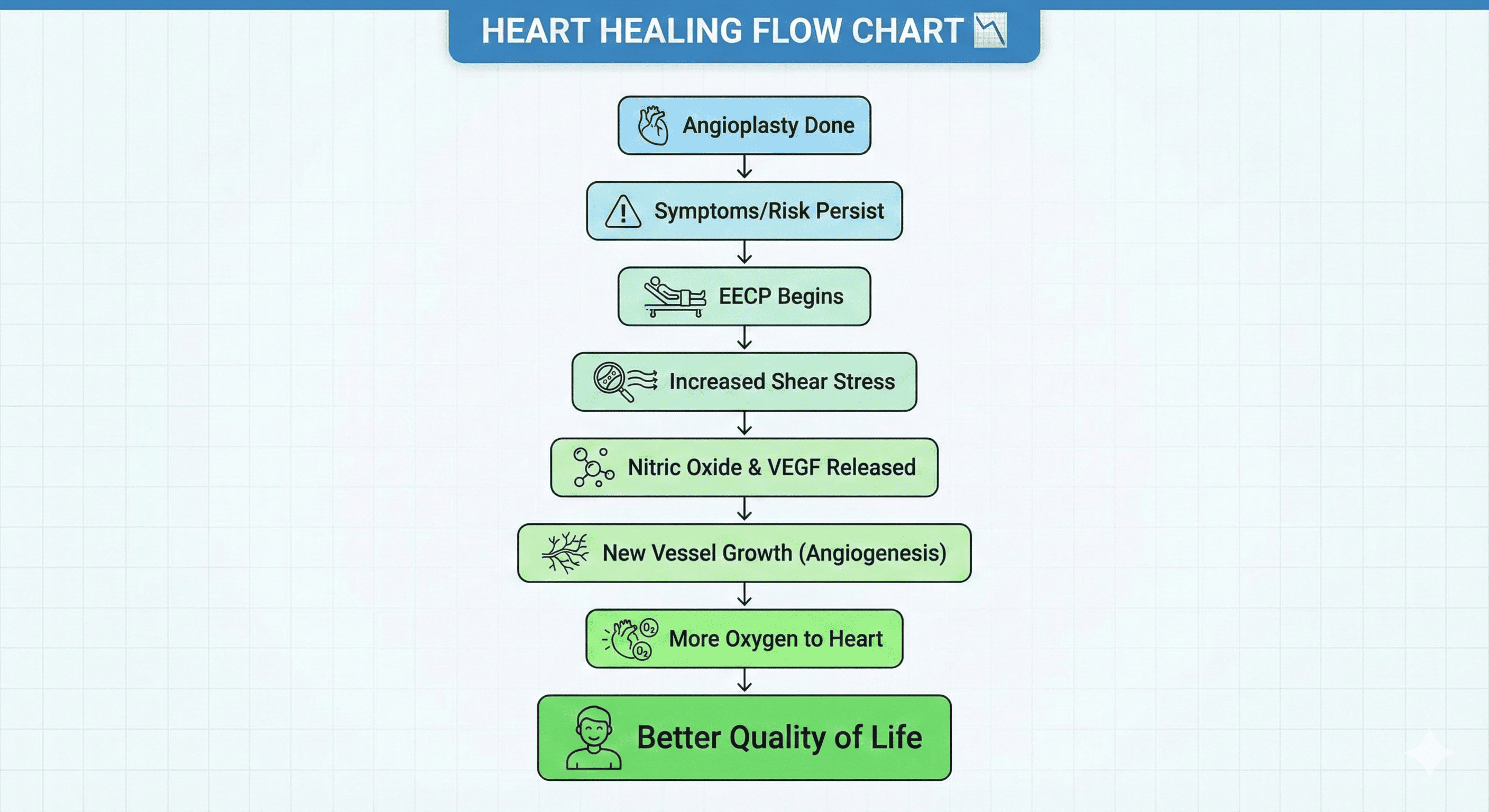
Step-by-Step Journey to Recovery
-
Diagnosis: After the angioplasty, the doctor uses a Stress Test or Echo to check how well the heart is working.
-
Eligibility: The patient is ready for EECP if they still have “ischaemia,” which means they don’t have enough oxygen.
-
Preparation: Before the procedure, the patient puts on comfortable leggings to avoid skin irritation.
-
The Session: The cuffs pulse in time with the ECG (heart monitor) for 60 minutes.
-
Monitoring: The blood oxygen level and heart rate are checked the whole time to make sure everything is safe.
-
Follow-up: The doctor checks the patient’s stamina and symptom relief every 5 to 10 sessions.
Clinical Research and Studies on EECP Treatment After Recovery from Angioplasty
| Study Name / Year | Sample Size | Methodology | Key Findings |
|---|---|---|---|
| MUST-EECP (1999) | 139 Patients | Randomized Controlled Trial | A big increase in the time it took for exercise-induced ischemia to happen. EECP was proven to work for stable angina. |
| IEPR Registry (2002) | 978 Patients | Registry Data (Post-CABG subset) | 81% of patients who had CABG reported a big drop in angina. Benefits maintained at the 2-year follow-up. |
| PEECH Trial (2005) | 187 Patients | Randomized Controlled Trial | EECP therapy benefits after surgery included better exercise duration and quality of life for people with heart failure. |
| Mayo Clinic (2002) | 97 Patients | Retrospective Analysis | Showed high survival rates (88% at 5 years) for high-risk post-bypass patients treated with EECP. |
| Loh et al. (2008) | 55 Patients | Comparison Study | Verified that EECP substantially enhances endothelial function (vascular health) in individuals with coronary artery disease. |
Questions that people often ask about EECP treatment after recovering from angioplasty
-
Is it safe to start EECP right after an angioplasty Doctors usually say to wait 4 to 6 weeks after the stent is put in to make sure the entry site in the wrist or leg is completely healed.
-
Does the treatment hurt? No. It feels like a strong, steady massage. Most patients find it very relaxing and even fall asleep during the session.
-
How long does a full course of EECP last? The standard protocol is 35 hours, which is usually done for 7 weeks, 1 hour a day, 5 days a week.
-
Can EECP take the place of my heart medicines? It doesn’t replace anything, but it often lets your doctor lower the dose of some of the drugs used to treat angina after angioplasty.
-
How well does EECP work for recovery after angioplasty? Clinical data indicates that approximately 80-85% of patients experience significant enhancement in their symptoms and energy levels.
-
Will I have to have the treatment again in the future? A lot of patients say the results last for three to five years. Staying healthy will help the results last even longer.
-
Does insurance cover EECP? EECP is covered in many countries for chronic stable angina that doesn’t get better with other treatments.
-
Can I drive myself home after a session? Yes! You can drive and go back to your normal daily activities right away because there is no anaesthesia or sedation.
-
How does EECP help if I already have a stent? The stent opens one big artery, but EECP opens thousands of tiny ones, which makes sure that the whole heart muscle gets the blood it needs.
-
What will happen if I miss a session? You won’t lose progress if you miss one or two days, but to get the most out of it, you should stick with it.
-
Is it a “Non-Surgical Treatment for Recovery After Angioplasty”? Yes, it is completely non-invasive. You don’t need any cuts, needles, or a hospital stay.
-
Does it help blood flow to other parts of the body? Yes, it helps the brain and kidneys as well because it makes the circulatory system healthier overall.
-
Is there an age limit for EECP? No. It can be done on both young and old patients as long as they meet the criteria for being a good candidate.
-
What should I wear to my sessions? Most clinics recommend wearing tight-fitting cotton leggings or “cycling shorts” to keep the cuffs from rubbing against the skin.
-
Why isn’t EECP more well-known? It is becoming more and more popular, but because it is a non-surgical treatment, it doesn’t always get as much advertising as “big-ticket” surgeries.
Final Summary
EECP Treatment After Angioplasty Recovery is a strong, science-based tool that helps people with heart problems get their lives back. Getting a stent is often just the first step. To stay out of the hospital for a long time, you need to make sure that your heart has a strong network of blood vessels. You are investing in a “natural bypass” that makes your heart muscle stronger, eases pain, and gives you more energy by choosing EECP Therapy for After Angioplasty Recovery.
Don’t settle for a life of limitations if you still feel the effects of heart disease after your surgery. This Non-Surgical Treatment for After Angioplasty Recovery is a safe and effective way to get better. Talk to a doctor about how to include EECP After Angioplasty Recovery in your plan for heart health.
Book An Appointment With Us
Experience top-quality healthcare at NexIn Health Clinic. Schedule your appointment with our expert team today for personalized and compassionate medical care. Book now to prioritize your health and well-being!
Get Appointment With Nexin health
Choose Nexin healthy For Heart
Treatments!
- TAVI/TAVR
- Heart Surgery
- ASD/VSD/PDA Device
- Device Closure
- Angina Treatment
- Heart Failure
- Heart Attack
- Chest Pain
- Hypertension
- Heart Diseases
- Heart Holes Surgery

13 Years of Experience
Our clinic has a rich history of delivering quality care, backed by over a decade of expertise in the field.
25,000 Patients Treated
We have a proven track record of successfully treating a diverse range of patients, demonstrating our commitment to effective and personalised care.
Non-Invasive Treatments
We specialise in advanced, non-invasive treatment options that focus on your well-being without the need for surgical procedures.
Our Main Treatments
EECP
Heart Blockage
Heart Failure
Angina
Chest Pain

13+
Experience

25+
Certified Therapists

25000+
Satisfied Patients
Book An Appointment
Contact us